
More Information
Submitted: February 13, 2026 | Accepted: May 29, 2026 | Published: June 01, 2026
Citation: Gholipour Y, Mostafaee A, Gholipour Y. Analytical Report on Digital Twin Technology: Status and Future Direction. J Plant Sci Phytopathol. 2026; 10(2): 22-25. Available from:
https://dx.doi.org/10.29328/journal.jpsp.1001167
DOI: 10.29328/journal.jpsp.1001167
Copyright license: © 2026 Gholipour Y, et al. This is an open access article distributed under the Creative Commons Attribution License, which permits unrestricted use, distribution, and reproduction in any medium, provided the original work is properly cited.
Keywords: Digital twin; Gartner hype cycle; Predictive maintenance; Digital transformation; Artificial intelligence in industry; Physical asset management

Analytical Report on Digital Twin Technology: Status and Future Direction
Yousof Gholipour1*, Amin Mostafaee1 and Yasser Gholipour2
1Department of Management, Najafabad Branch, Islamic Azad University, Najafabad, Iran
2Department of Management, Shahid Beheshti University, Tehran, Iran
*Address for Correspondence: Yousof Gholipour. Department of Management, Najafabad Branch, Islamic Azad University, Najafabad, Iran, Email: [email protected]
Digital twin (DT), a dynamic virtual representation of a physical entity synchronized through real-time data, is at a critical juncture in its evolution. This paper provides a comprehensive analysis of the current market position and future trajectory of DT, framed within the framework of Gartner’s Hype Cycle methodology. Our research definitively places the technology in “disappointment landing,” a stage marked by the fading of initial hype and the growing recognition of significant barriers to implementation, including data integration complexities, high costs, and a shortage of skilled talent. Despite these challenges, this analysis identifies a clear path to maturity and predicts progress through an “enlightenment slope” driven by standardization, AI integration, and the emergence of federated models. We predict that DTs will reach a “productivity plateau” for specific, asset-intensive industries within 5 to 7 years. Ultimately, this paper argues that the successful adoption of this technology and its long-term value depend less on its technical capabilities and more on key organizational factors: a clear and defined strategic vision, a strong data infrastructure, and the fostering of a collaborative and data-driven culture. The findings provide a strategic roadmap for practitioners and policymakers navigating the evolving landscape of digital transformation.
Definition and potential applications
A digital twin is a digital model of an intended or actual real-world physical product, system, or process (a physical twin) that serves as a digital counterpart of it for purposes such as simulation, integration, testing, monitoring, and maintenance [1].
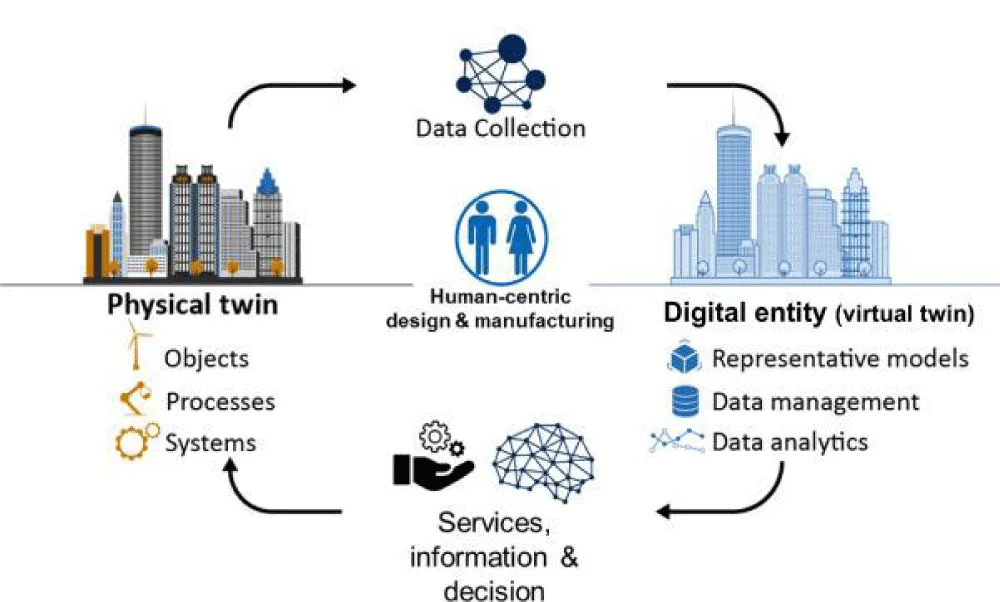
A digital twin is “a set of adaptive models that emulate the behaviour of a physical system in a virtual system, getting real-time data to update itself along its life cycle. The digital twin replicates the physical system to predict failures and opportunities for changing, to prescribe real-time actions for optimizing and/or mitigating unexpected events, observing and evaluating the operating profile of the system [2]. A Digital Twin (DT) is a dynamic, virtual representation of a physical object, system, or process that is synchronized across its lifecycle using data, simulation, and machine learning [3]. It is not merely a 3D CAD model; it is a living, data-driven model that updates and changes as its physical counterpart changes. This bidirectional flow of information allows the digital twin to both reflect the state of the physical asset and influence its operation.
The core components of a digital twin include:
The Physical Entity: The asset in the real world, equipped with sensors.
The Virtual Model: The digital replica in a computational environment.
The Connecting Data Link: The continuous, real-time data flow that synchronizes the physical and virtual worlds.
Potential applications across industries
Manufacturing & Industry 4.0: DTs are used for predictive maintenance, virtual factory planning, and real-time process optimization. For instance, Siemens uses digital twins to simulate and optimize production lines, reducing commissioning time and physical prototyping costs [4].
Healthcare: Patient-specific digital twins can simulate the effects of treatments or surgeries, enabling personalized medicine. Researchers are developing “human heart twins” to model cardiac conditions and test interventions [5].
Urban Planning & Smart Cities: City-scale digital twins help model traffic flows, energy consumption, and the impact of new infrastructure projects. The city of Helsinki’s virtual model is a leading example used for public engagement and urban development [6].
Aerospace: NASA was an early pioneer, using digital twin concepts for the Apollo program. Today, companies like Boeing use DTs to monitor aircraft health in real-time, predicting part failures before they occur [7].
Analysis of technology status based on the gartner hype cycle
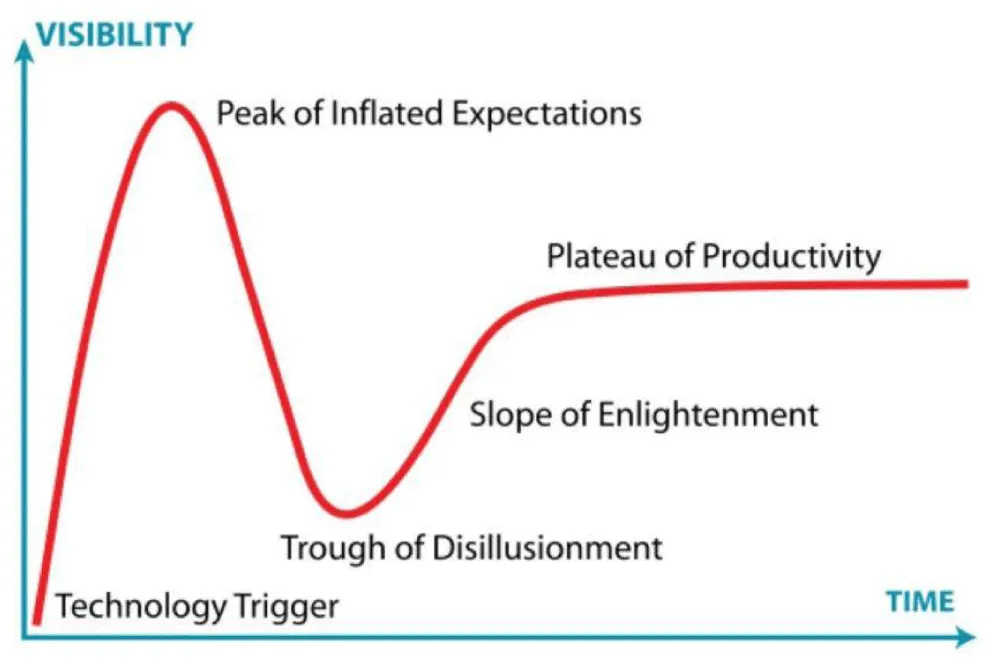
According to Gartner’s most recent analyses, Digital Twin technology is currently navigating the “Trough of Disillusionment.”
Evidence for this placement:
Peak of Inflated Expectations (Past): Around 2017-2019, hype around digital twins was immense, with promises of revolutionizing every industry overnight. The term was often used loosely for any sophisticated simulation or 3D model, leading to inflated expectations [8].
Entering the Trough of Disillusionment (Present): As organizations embarked on pilot projects, they encountered significant challenges. These include the high cost of implementation, data integration complexities from siloed systems, a shortage of skilled talent, and cybersecurity concerns. A survey by the IEEE World Forum on Internet of Things highlights data integration and security as primary barriers to adoption [9]. Media coverage has shifted from pure excitement to more critical discussions of these hurdles.
Moving Towards the Slope of Enlightenment: There is growing evidence of early, tangible success stories. Companies that focused on specific, high-value use cases (e.g., predictive maintenance on critical assets) are reporting significant ROI. The market continues to grow, with Marketsand Markets (2023) [10] projecting the global DT market to grow from USD 10.1 billion in 2023 to USD 110.1 billion by 2028, indicating sustained, albeit more realistic, investment.
Download Image
Figure 1: Illustration of the bidirectional flow between the Physical Twin (e.g., urban infrastructure, machinery) and the Digital Entity (Virtual Twin), emphasizing human-centric design and manufacturing, data collection, and services like predictive maintenance and resource optimization [11].
Future directions prediction
To ascend the “Slope of Enlightenment” and reach the “Plateau of Productivity,” digital twin technology will likely follow this path:
Short-Term (Next 2-3 Years): Standardization and Interoperability.
Focus: The industry will develop and adopt common standards and open architectures to solve data interoperability issues. This will allow twins of different components to form a “system of systems” or a “twin of twins.”
Driver: Consortiums like the Industrial Digital Twin Association (IDTA) are already working on this. Cloud platforms (AWS, Microsoft Azure, Google Cloud) will offer more standardized DT frameworks.
Mid-Term (3-5 Years): AI-based autonomy and federal twins.
Focus: AI and machine learning will evolve from providing insights to enabling autonomous decision-making. The concept of “federated digital twins” will emerge, where multiple organizations can securely contribute data to a shared twin without losing control of their proprietary information.
Driver: Advancements in edge computing and AI algorithms will make real-time, closed-loop control a reality for more applications.
Long-Term (5-8 Years): Widespread Proliferation and Ecosystem Integration.
Focus: Digital twins will become a standard business tool for asset-intensive industries. They will be deeply integrated with other technologies like the Metaverse for immersive interaction and Blockchain for secure data provenance.
Timeline to Plateau: It is estimated that digital twins will begin entering the Plateau of Productivity for specific, well-defined domains (like manufacturing and aerospace) within 5-7 years, while broader, cross-industry adoption will take closer to a decade.
Analysis of success and failure factors
The ultimate success and maturation of digital twin technology hinge on several key factors:
Factors for Success and Widespread Adoption:
Clear Business Value & Use Case Focus: Projects that start with a specific, high-ROI problem (e.g., reducing unplanned downtime) are more likely to succeed and secure funding.
Robust Data Infrastructure: Success depends on the ability to collect, clean, and integrate high-quality, real-time data from diverse sources.
Advancements in Enabling Technologies: Progress in AI, IoT, 5G/6G connectivity, and cloud computing will lower technical barriers and enhance DT capabilities.
Standardization and Open Ecosystems: Widespread adoption requires interoperability standards that prevent vendor lock-in and allow for scalable systems.
Cybersecurity and Trust: Establishing robust security frameworks to protect the critical data and models is non-negotiable for user trust.
Factors Leading to Failure or Stagnation: Lack of a Strategic Vision: Treating a DT as a one-off IT project rather than a strategic, business-led initiative.
Overwhelming Complexity and Cost: Underestimating the resources required for data management, model development, and continuous upkeep can lead to project abandonment.
Organizational Silos and Cultural Resistance: Failure to break down data and departmental silos, coupled with resistance to new, data-driven workflows, can derail implementation.
Talent Gap: A significant shortage of professionals skilled in data science, domain expertise, and systems engineering can slow down progress.
This comprehensive analysis has systematically investigated the trajectory of Digital Twin technology, revealing its transition from a hyped concept to a pragmatically evolving tool with transformative potential. Our investigation positioned Digital Twins within the Gartner Hype Cycle, conclusively identifying its current location in the “Trough of Disillusionment.” This phase is characterized by a necessary market correction, where initial, often inflated, expectations have given way to the complex realities of implementation. The evidence for this includes widespread recognition of significant challenges, such as data integration complexities from siloed systems, high initial costs, and a pronounced skills gap. However, this period is not a decline but a critical consolidation, separating speculative ventures from projects delivering tangible value in focused applications like predictive maintenance and virtual prototyping.
Looking forward, our investigation forecasts a clear path toward maturity. Digital Twins are expected to ascend the “Slope of Enlightenment” over the next 2-5 years, driven by three key developments: the establishment of crucial interoperability standards, the deep integration of AI for autonomous decision-making, and the emergence of federated models enabling secure cross-organizational collaboration. The technology is predicted to begin reaching the “Plateau of Productivity” for core sectors like manufacturing and aerospace within 5-7 years, eventually becoming a standard business tool.
Ultimately, our analysis concludes that the long-term success of Digital Twins will be determined less by technological capability alone and more by critical organizational and strategic factors. Success hinges on establishing a clear business case with defined ROI, developing robust data governance frameworks, and fostering a culture that embraces data-driven workflows. The journey from a promising prototype to a productive enterprise asset is paved not just with sensors and algorithms, but with strategic vision, cross-domain collaboration, and a resolved commitment to navigating the complexities of digital transformation.
- Moi T, Cibicik A, Rølvåg T. Digital twin based condition monitoring of a knuckle boom crane: An experimental study. Eng Fail Anal. 2020;112:104517. Available from: https://dx.doi.org/10.1016/j.engfailanal.2020.104517.
- Semeraro C, Lezoche M, Panetto H, Dassisti M. Digital twin paradigm: A systematic literature review. Comput Ind. 2021;130:103469. Available from: https://dx.doi.org/10.1016/j.compind.2021.103469.
- Tao F, Sui F, Liu A, Qi Q, Zhang M, Song B, et al. Digital twin-driven product design, manufacturing and service with big data. Int J Adv Manuf Technol. 2019;94:3563-76. Available from: https://dx.doi.org/10.1007/s00170-017-0233-1.
- Siemens. Digital Twin. Siemens AG. 2023. Available from: https://www.siemens.com/global/en/products/automation/industry-software/automation-software/digital-enterprise/digital-twin.html.
- Corral-Acero J, Margara F, Marciniak M, Rodero C, Loncaric F, Feng Y, et al. The ‘Digital Twin’ to enable the vision of precision cardiology. Eur Heart J. 2020;41(48):4556-64. doi:10.1093/eurheartj/ehaa159.
- Helsinki. Helsinki 3D+. City of Helsinki. 2023. Available from: https://www.hel.fi/helsinki/en/administration/information/general/3d.
- Glaessgen E, Stargel D. The digital twin paradigm for future NASA and U.S. Air Force vehicles. 53rd AIAA/ASME/ASCE/AHS/ASC Structures, Structural Dynamics and Materials Conference. 2019. Available from: https://dx.doi.org/10.2514/6.2012-1818.
- Panetta K. 5 Trends Drive the Gartner Hype Cycle for Emerging Technologies, 2019. Gartner. 2019 Aug 29. Available from: https://www.gartner.com/smarterwithgartner/5-trends-drive-the-gartner-hype-cycle-for-emerging-technologies-2019.
- Minerva R, Lee GM, Crespi N. Digital Twin in the IoT Context: A Survey on Technical Features, Scenarios, and Architectural Models. Proc IEEE. 2022;110(10):1632-58. Available from: https://dx.doi.org/10.1109/JPROC.2022.3203005.
- MarketsandMarkets. Digital Twin Market by Enterprise, Application (Predictive Maintenance, Business Optimization), Industry (Aerospace & Defense, Automotive & Transportation, Healthcare & Life Sciences, Residential & Commercial, Energy & Utilities), and Region - Global Forecast to 2028. MarketsandMarkets. 2023. Available from: https://www.marketsandmarkets.com/Market-Reports/digital-twin-market-225269522.html.
- Iranshahi K, Brun J, Arnold T, Sergi T, Müller UC. Digital twins: Recent advances and future directions in engineering fields. Intell Syst Appl. 2025;26:200516. Available from: https://dx.doi.org/10.1016/j.iswa.2025.200516.