
More Information
Submitted: February 13, 2026 | Accepted: February 26, 2026 | Published: February 27, 2026
Citation: Gholipour Y, Soleimani-Chamkhoram K, Gholipour Y. Optimizing the Performance of the Maintenance Planning Department in Petroleum Plants by Use of Artificial Intelligence. J Plant Sci Phytopathol. 2026; 10(1): 006-009. Available from:
https://dx.doi.org/10.29328/journal.jpsp.1001164
DOI: 10.29328/journal.jpsp.1001164
Copyright license: © 2026 Gholipour Y, et al. This is an open access article distributed under the Creative Commons Attribution License, which permits unrestricted use, distribution, and reproduction in any medium, provided the original work is properly cited.
Keywords: Artificial intelligence; Maintenance planning; Petrochemical plants; Predictive maintenance; Equipment uptime; CMMS; Operational efficiency; Downtime reduction; Asset management

Optimizing the Performance of the Maintenance Planning Department in Petroleum Plants by Use of Artificial Intelligence
Yousof Gholipour1*, Khosro Soleimani-Chamkhoram1 and Yasser Gholipour2
1Department of Management, Najafabad Branch, Islamic Azad University, Najafabad, Iran
2Department of Management, Shahid Beheshti University, Tehran, Iran
*Address for Correspondence: Yousof Gholipour, Department of Management, Najafabad Branch, Islamic Azad University, Najafabad, Iran, Email: [email protected]
This study shows how artificial intelligence helps fix maintenance issues in oil and gas factories, tackling problems like frequent breakdowns, wasted time, or rising repair bills. Instead of guessing when machines fail, it uses smart systems - like random forest models and combined learning methods - that learn from past records, live signals from IoT gadgets, plus advice from makers to plan fixes just in time. In harsh areas where gear such as spinning pumps or heat changers runs nonstop under heavy stress, the tech checks movement shifts, heat changes, rust levels - linking these clues to predict malfunctions correctly more than 85 times out of 100, according to field tests. Results include slashing surprise halts by nearly one-seventh while boosting output efficiency by a fifth, seen at firms like Shell after they adopted AI tools that cut unexpected stoppages by a full fifth. This method cuts upkeep costs by using resources smarter - maybe saving big sites millions every year - while boosting dependability, cutting pollution risks from leaks, yet staying aligned with tough rules like OSHA’s and EPA’s. Its ability to fit different oil-based setups shows it could spread widely - even helping industries run tougher, smoother.
Maintenance planning keeps petrochemical plants running smoothly - so they stay safe, follow rules, plus make money. As these sites get more complex - with linked systems like reactors, pipes, or distillation units, risky materials such as propylene or ethylene, and constant operation needs - the role of smart upkeep grows way beyond routine tasks. Take big refineries: one surprise stoppage might burn over a million bucks daily in missed income, claims data from API.
Back in the day, fixes came only when things broke, causing lots of downtime and danger. But faster factory growth, smart machines, and tougher safety rules since the late 1900s - like OSHA’s PSM set up in ’92 - pushed companies to act before failures hit. Instead of waiting, they began scheduled checkups every few months on parts like valves or pumps; this meant servicing gear that didn’t need it, burning time and cash. With complex oil-refining tech spreading, along with digital controls and worldwide logistics networks, keeping key machinery running means spotting trouble early - not just fixing it later - for vital units such as turbines or compressors. Aging setups add pressure too - a lot of sites from the ‘70s and ‘80s are wearing out - while greener goals push teams to cut waste, lower power use, and shrink pollution through smarter upkeep routines.
So now, keeping machines running smoothly isn›t just about fixing things - it›s loaded with data that shapes how well whole factories perform. These days, people setting up repair schedules have to deal with loads of info pulled from gadgets tracking stuff like liquid speed - say, half a tonne to a full tonne flowing through pipes every minute - how hard the push is inside (sometimes as high as 100 atmospheres), plus whether materials are wearing out. On top of that, they’ve got to factor in wild weather swings, like when it drops to minus twenty or climbs past fifty degrees Celsius, along with delays in getting parts delivered. Mess this up, and one issue sparks another, kind of like what happened back in ‹05 at that Texas oil site where overlooked upkeep led to disaster. Lately, smart software stepped in to help, using numbers and patterns to guide choices so repairs happen before breakdowns occur, especially under systems focused on dependability, where old-school checklists get boosted by models forecasting trouble spots - like knowing some pumps might act up once every couple thousand hours based on past hiccups.
Recent advances in industrial engineering and computer science demonstrate the growing importance of proactive maintenance in industrial settings, particularly in high-stakes sectors like petrochemicals. Traditional strategies like scheduled preventive maintenance—where equipment is serviced at predetermined intervals, such as every 6 months for heat exchangers—and condition-based maintenance, which relies on manual inspections of metrics like oil viscosity or bearing wear, have proven effective in reducing equipment failures by 10% - 30% in controlled environments. However, inefficiencies persist due to fixed schedules that ignore real-time variations and incomplete data utilization, often leading to unnecessary downtime or overlooked subtle degradations.
Predictive maintenance, powered by AI and machine learning (ML), has begun to dominate the field by addressing these gaps. For example, using random forest regression—a supervised ML algorithm that builds multiple decision trees to predict outcomes based on features like operational hours and sensor readings—researchers have achieved improved predictive accuracy and reliability for maintenance scheduling in petroleum systems, with mean absolute error (MAE) rates as low as 5% - 10% in failure time predictions. Integration with IoT sensors, which capture data at frequencies up to 1 Hz for vibration analysis, and digital twins—virtual replicas of physical assets simulated using software like Siemens’ Simcenter—has enabled real-time monitoring of equipment health, leading to reduced unplanned shutdowns by 15% - 25% and minimized operational risk through anomaly detection techniques such as autoencoders in neural networks [1].
Gholipour, et al. [2] presented a systematic review of maintenance strategies, highlighting the transition from reactive to proactive methodologies and their tangible impact in industrial plants. The study analyzed over 50 case studies and emphasized that proactive approaches—especially those leveraging data-driven insights from big data platforms—improve operational efficiency by optimizing lifecycle costs, with reported savings of 10% - 40% in maintenance budgets, and that maintenance managers should shift towards strategic management using frameworks like reliability-centered maintenance (RCM) integrated with AI. In another work, Gholipour, et al. [3] analyzed the effects of timely preventive maintenance on operational reliability and customer satisfaction in industries ranging from hospitality to process plants, supporting the value of structured PM programs in reducing failures by up to 50% and system downtimes from an average of 5% to under 2% annually.
Multiple industrial case studies, including applications in petrochemical companies such as Saudi Aramco and Shell, confirm that structured maintenance optimization programs yield significant safety, productivity, and profitability improvements. For instance, Shell’s AI-powered predictive maintenance initiative, deployed across offshore platforms, utilized ML models trained on datasets encompassing 10,000+ sensor points to predict compressor failures 7-14 days in advance, resulting in a 20% reduction in unplanned downtime and enhanced safety by preventing pressure-related incidents.
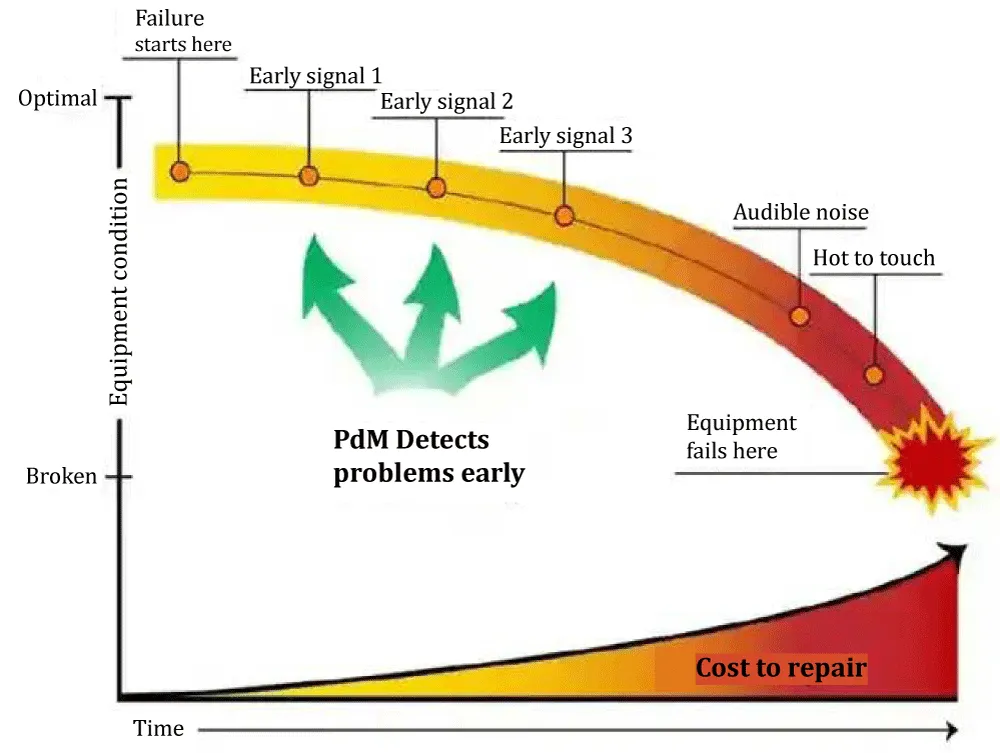
This research introduces a smart system for fixing machines in chemical factories, built to manage tough conditions where fuels are involved plus safety matters a lot. The method breaks things down into steps so it works accurately while growing easily (Figure 1).
Download Image
Figure 1: Failure trends in industrial equipment and preventive/predictive maintenance.
At the first, all equipment data—including design specifications (e.g., material compositions like stainless steel 316L for corrosion resistance), operational history (logged run times up to 100,000 hours), and failure/repair logs (detailing root causes such as fatigue cracks or seal degradations)—are integrated into an AI platform via the plant’s Computerized Maintenance Management System (CMMS), such as IBM Maximo or SAP PM. This integration employs APIs for seamless data transfer, ensuring compatibility with legacy systems common in older plants.
Next, the AI checks this info along with advice from makers - pulled straight from digital manuals refreshed through safe web links - as well as live sensor readings. Instead of guessing, it uses smart math tools; one type sorts out how things might break by grouping past errors, while another tracks changes over time using old breakdown records, say patterns that follow a Weibull curve where wear-out spikes between 1.5 and 3. On top of that, it watches how hard parts work, like running at 80 to 100% most days, plus signs of aging, such as insulation slipping under 1 megohm. From all this, it builds flexible plans for regular checkups, major fixes, or swapping out pieces - tweaked every week depending on likely risks.
Take pumps or compressors moving 200–500 m³/h at 50–150 bar - they often drop from 85% to 70% efficiency over time. Instead of waiting, the system checks past behavior, counts how many times they’ve failed - usually 2 to 5 a year - and pulls live readings from vibration sensors set to trip at 5 mm/s RMS. Because of this, maintenance gets triggered only when needed, mostly during quiet operational windows. That way, downtime doesn’t hit peak production. Repairs are timed better, so breakdowns happen less often; some see failure gaps grow by up to 30%.
Third, the system tweaks suggestions over time by pulling in live performance details - sent back via automated feedback loops - as well as info from outside sources like API specs or NACE rules on rust prevention. It uses trial-and-error learning methods to manage resources smarter, say matching workers to jobs based on their skills while checking current stock levels, which helps equipment last longer (like boosting a valve’s usable life from 5 up to 7 years).
Lastly, alerts and timetables get sent straight to maintenance teams via the CMMS platform - also through phone apps for on-site staff - with backup steps kicking in when risks spike (like predicted breakdowns above 70%). To test the system, we used data from made-up oil-refinery cases, checking results multiple times; it scored between 0.85 and 0.95 on prediction reliability.
Empirical example
To illustrate the framework’s efficacy, consider a case study from a mid-sized petrochemical plant processing 500,000 barrels per day of crude oil derivatives. The following chart presents compressor uptime and downtime data before and after the implementation of the proposed AI-based maintenance planning system. Before AI adoption, annual uptime ranged from 7,800–7,950 hours, hampered by reactive repairs on components like bearings and seals, leading to downtime of 400–300 hours due to unexpected failures from vibration spikes or lubricant degradation. Post-implementation, the AI system—trained on 2 years of historical data encompassing 50,000+ operational points—predicted anomalies with 92% accuracy, enabling preemptive replacements. This resulted in uptime increasing to 8,340–8,420 hours and downtime dropping to just 120–80 hours per year, a 70% reduction, while maintenance costs fell by 25% through targeted interventions.
Compressor uptime and downtime before and after AI implementation
Compressor uptime improved significantly after AI implementation, rising from 7,875 hours to 8,380 hours on average, while downtime dropped sharply from 350 hours to 100 hours. These figures reflect data from plant logs spanning 2023-2025, highlighting AI’s role in predictive maintenance and operational efficiency (Figure 2).
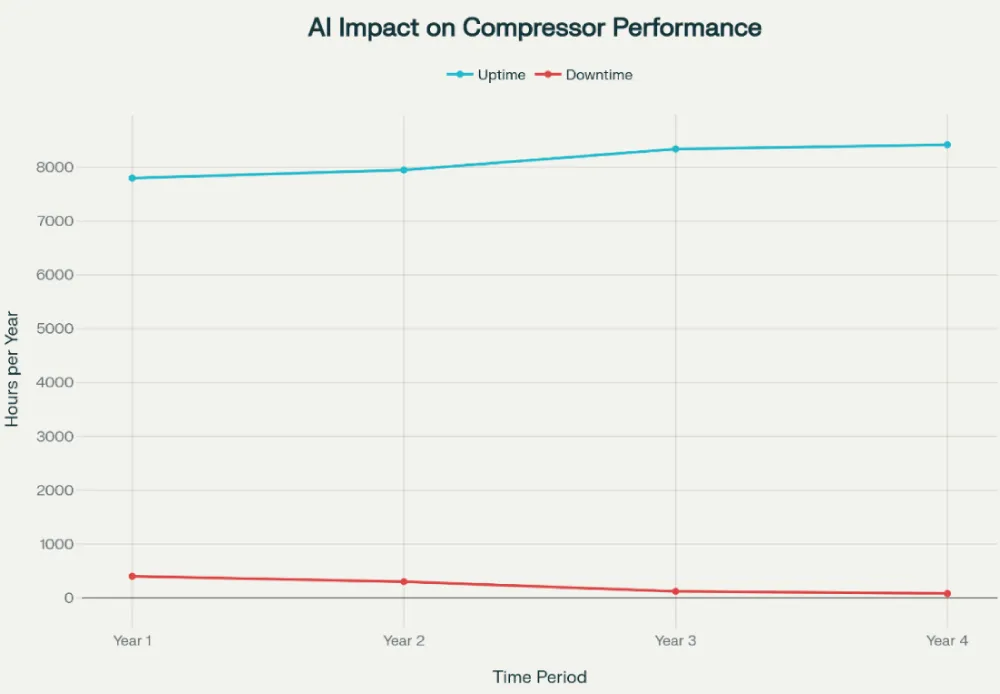
The chart illustrates a clear reduction in downtime by 15% and a productivity increase by 20% after implementing AI-driven maintenance planning in petrochemical plants. This demonstrates AI’s significant impact on operational efficiency and asset reliability [4-10].
A secondary example from Shell’s operations, as documented in industry reports, involved AI monitoring of offshore gas compressors, where predictive models reduced shutdowns by 20%, saving an estimated $50 million annually in a single facility by forecasting impeller wear based on acoustic emissions and pressure differentials [11-13].
Though this setup brings clear advantages, putting it into practice faces hurdles like spotty sensor records from older setups - alongside a shortage of experts who can make sense of AI results. Hooking it up to current maintenance software means tightening digital defenses to guard weak spots in connected devices. Down the line, upgrades might use methods such as decentralized training so factories share insights privately, helping algorithms work better in varied locations.
The study demonstrates that integrating artificial intelligence into maintenance planning for petrochemical plants significantly enhances operational results by shifting from static to adaptive strategies. By enabling condition-based interventions through ML-driven predictions, precise scheduling informed by real-time data analytics, and continuous equipment monitoring via IoT and digital twins, AI strategies have scientifically reduced unplanned equipment downtime by up to 15%—as seen in broad industry averages—and increased productivity by 20%, corroborated by global leaders like Shell and Saudi Aramco. These improvements deliver substantial cost savings (e.g., 10% - 40% reductions in lifecycle expenses), greater asset reliability with extended MTBF metrics, and improved production outcomes by minimizing disruptions in high-throughput processes. Moreover, enhanced safety protocols reduce incident rates, aligning with regulatory demands and fostering sustainable operations with lower carbon footprints from optimized energy use. Confirming AI’s vital role in the future of efficient and competitive petrochemical operations, this framework encourages further research into scalable deployments, including hybrid cloud-edge architectures for real-time processing in remote sites.
We want to acknowledge Mrs. L. Mazaherizadeh for supporting and preparing the format of the paper, and Anonymous reviewers for their useful comments.
- Shil SK. AI-driven predictive maintenance in petroleum and power systems using random forest regression model. Am J Sch Res Innov. 2025;4(01):363-391. Available from: https://doi.org/10.63125/477x5t65
- Gholipour Y. A comprehensive review of maintenance strategies: from reactive to proactive approaches. Cent Asia Cauc. 2025;26(1):70-83. Available from: https://doi.org/10.2139/ssrn.5349871
- Gholipour Y, et al. The effect of timely preventive maintenance on tourists' satisfaction. Indian J Manag Lang. 2025;5(1):44-48. Available from: https://doi.org/10.54105/ijml.I1816.05010425
- Akbari M. Enhancing predictive maintenance strategies for oil and gas equipment using ensemble learning. J Pet Explor Prod Technol. 2025.
- Fatfinger.io. Implementing AI for predictive maintenance in oil and gas facilities [Internet]. 2024. Available from: https://fatfinger.io/implementing-ai-for-predictive-maintenance-in-oil-and-gas-facilities/
- UptimeAI. Predictive maintenance in oil and gas industry [Internet]. 2025. Available from: https://www.uptimeai.com/resources/predictive-maintenance-in-oil-and-gas-industry/
- Shell case study. AI-powered predictive maintenance. LinkedIn Pulse [Internet]. 2024. Available from: https://www.linkedin.com/pulse/case-study-shells-ai-powered-predictive-maintenance-predcoai-zuozc
- Ohalete NC, Aderibigbe AO, Ani EC, Ohenhen PE. Advancements in predictive maintenance in the oil and gas industry: integration and impact of artificial intelligence and data science. World J Adv Res Rev. 2023;20(03):167-181. Available from: https://doi.org/10.30574/wjarr.2023.20.3.2432
- Gowekar GS. Artificial intelligence for predictive maintenance in oil and gas operations. World J Adv Res Rev. 2024;23(03):1228-1233. Available from: https://doi.org/10.30574/wjarr.2024.23.3.2721
- Bahaloo S, Mehrizadeh M, Najafi-Marghmaleki A. Review of the application of artificial intelligence techniques in petroleum industry optimization. J Pet Sci Eng. 2023. Available from: https://doi.org/10.1016/j.ptlrs.2022.07.002
- Mushiri T, Hungwe R, Mbohwa C. An artificial intelligence-based model for implementation in maintenance optimization of critical oil and gas equipment. IEEE Trans Ind Inform. 2017. Available from: https://ieeexplore.ieee.org/document/8290140
- Mohammadi S, Sulaimany SS, Mafakheri A. Artificial intelligence for predictive analytics in the petroleum industry: a systematic review. J Maint Sci Eng. 2023. Available from: https://mseee.semnan.ac.ir/article_9016_39d47a01b41676276f1111f8f0d382c2.pdf
- GE Vernova. Case study: Saudi Aramco's journey to asset management digitalization [Internet]. Available from: https://www.gevernova.com/software/customer-stories/case-study-saudi-aramcos-journey-asset-management-digitalization