
More Information
Submitted: December 16, 2025 | Accepted: December 24, 2025 | Published: December 26, 2025
Citation: Faruk I, Akhter S, Islam R, E-Elahi F, Tabassum TH, Siddiky A. Nematicidal Potential of Neem (Azadirachta indica A. Juss) Based Products against Root-Knot Nematode (Meloidogyne incognita) and Yield Enhancement in Tomato. J Plant Sci Phytopathol. 2025; 9(3): 097-104. Available from:
https://dx.doi.org/10.29328/journal.jpsp.1001161
DOI: 10.29328/journal.jpsp.1001161
Copyright license: © 2025 Faruk I, et al. This is an open access article distributed under the Creative Commons Attribution License, which permits unrestricted use, distribution, and reproduction in any medium, provided the original work is properly cited.
Keywords: Neem; Meloidogyne incognita; Tomato; Nematicidal activity; Neem cake; Yield enhancement

Nematicidal Potential of Neem (Azadirachta indica A. Juss) Based Products against Root-Knot Nematode (Meloidogyne incognita) and Yield Enhancement in Tomato
Iqbal Faruk1*, Shamim Akhter2, Rummana Islam2, Ferdous E-Elahi2, Tasfia Hassan Tabassum3 and Alamgir Siddiky1
1Principal Scientific Officer, Regional Agricultural Research Station, Bangladesh Agricultural Research Institute, Cumilla, Bangladesh
2Senior Scientific Officer, Plant Pathology Division, Bangladesh Agricultural Research Institute, Gazipur, Bangladesh
3Scientific Officer, Bangladesh Agricultural Research Institute, Gazipur, Bangladesh
*Address for Correspondence: Dr. Md. Iqbal Faruk, Principal Scientific Officer, Plant Pathology Division, Regional Agricultural Research Station, Bangladesh Agricultural Research Institute, Cumilla, Bangladesh, Email: [email protected]; [email protected]
Root-knot nematode (Meloidogyne incognita) is one of the most destructive soil-borne pathogens that severely affects tomato (Solanum lycopersicum L.) production worldwide, including Bangladesh, causing significant yield losses. The present study was conducted to evaluate the nematicidal potential of neem (Azadirachta indica A. Juss) based products for the management of M. incognita and their effects on tomato growth and yield under both pot culture and field conditions during 2017-18, 2018-19, 2019-20, and 2020-21 cropping seasons. Different neem formulations, including neem seed extract, neem leaf extract, neem oil, and commercial neem cake, were applied to artificial root knot nematode-infested soil amendment. In pot house condition, all neem based product was effective against root knot nematode and increased plant growth parameters. In the field condition, results revealed that all neem products significantly reduced root-knot gall index, and increased plant growth parameters such as shoot and root growth, as well as fruit number and yield of tomato compared to the untreated control. Among the tested treatments, neem oil cake and neem seed extract treatment exhibited the best nematicidal activity, with a reduction in gall index and remarkable improvement in plant height, shoot weight, root weight, fruit number, and total yield of tomato. Neem leaf extract, neem leaf powder, and chemical nematicide Furadan 5G treatments also performed better in the reduction of gall index, improving plant growth and yield of tomato compared to the untreated control. These findings suggest that neem-based products, particularly neem oil cake and neem seed extract, are effective, eco-friendly alternatives to synthetic nematicides for sustainable root-knot nematode management and yield improvement in tomato production systems.
Tomato (Solanum lycopersicum L.) belongs to the family Solanaceae and is one of the most important vegetable crops cultivated worldwide for its high nutritional and economic value. It ranks next to potato and sweet potato in respect of vegetable production in the world [1,2]. However, its productivity is severely constrained by plant-parasitic nematodes, particularly root-knot nematodes (Meloidogyne spp.), among which Meloidogyne incognita is the most prevalent and destructive species [3,4]. These obligate endoparasites induce characteristic root galls that interfere with the normal uptake of water and nutrients, leading to stunted growth, chlorosis, wilting, and substantial yield reduction [5,6]. Plant-parasitic nematodes have been implicated as a major constraint to tomato production [7]. Yield losses in tomato caused by M. incognita have been estimated to range between 30–100%, depending on the level of infestation and environmental conditions [8].
Chemical nematicides such as carbofuran, fenamiphos, and oxamyl were once widely used to suppress nematode populations; however, their extensive use has led to several adverse consequences, including environmental pollution, residue hazards to other beneficial soil micro flora, risks to human and animal health, high cost, and development of resistance [9-11]. In view of these limitations, there is a growing emphasis on identifying safer, biodegradable, and environmentally friendly alternatives for nematode management. Environmentally friendly alternatives management, like various soil amendments by green and compost manures, organic and inorganic fertilizers, botanicals, bio-control agents like nematophagous fungi, and soil bacteria, are found to be more satisfactory to reduce the nematode population and increase crop yield [12]. Among such alternatives, botanicals have attracted considerable attention due to their bioactive secondary metabolites with nematicidal, repellent, or antifeedant properties [13,14].
Plant-derived products, especially botanicals such as Azadirachta, Eucalyptus, Chrommelina, Sida acuta, and Targetis, have gained attention as sustainable substitutes due to their biodegradability, low toxicity, and multiple modes of action against pests and pathogens [9,15]. Neem (Azadirachta indica A. Juss), belonging to the family Meliaceae, is one of the most promising plant sources of natural nematicidal compounds. Its bioactive compounds, particularly azadirachtin, salannin, nimbin, and related limonoids, exhibit strong antifeedant, repellent, growth-disrupting, and nematicidal effects [16,17]. Various neem-based products such as neem seed cake, neem oil, neem leaf extract, and azadirachtin formulations have been shown to possess strong nematicidal activity against a wide range of plant-parasitic nematodes [18-20]. Moreover, neem products improve soil fertility and stimulate beneficial microbial populations, thereby enhancing overall plant vigor and yield [21,22]. In addition, neem products are compatible with integrated pest management (IPM) strategies and contribute to soil health improvement. However, in spite of the wide distribution of root-knot nematode on many crops in Bangladesh, little work has been done on the management of root-knot nematode in the country, and so far, no efforts have been made to exploit locally available botanicals, especially neem-based products, for the control of root-knot nematode. Considering the increasing demand for environmentally safe management practices, neem-based products represent a promising approach for the control of M. incognita in tomato cultivation. The present study was undertaken to assess the nematicidal potential of various neem-based products against M. incognita and to evaluate their influence on the growth and yield performance of tomato.
Pot house experiment
The study was conducted in the pot house of the Plant Pathology Division, BARI, Gazipur, during the Rabi season of 2017–18. Seven treatments were evaluated: i) Furadan (F) 5G @ 15 g pot⁻¹, ii) soil application of neem leaf powder @ 15 g pot⁻¹, iii) soil application of neem leaf extract (1:10 w/v), iv) soil application of neem seed extract (1:10 w/v), v) soil application of neem oil (1:10 v/v), vi) soil application of neem oil cake @ 100 g pot⁻¹, and vii) untreated control. The experiment followed a completely randomized design (CRD) with four replications. Pots were filled with sterilized loamy-sand soil. The sterilized soil was inoculated with chopped, severely galled roots of Indian spinach at a rate of 10 g kg⁻¹ of soil. Neem leaf extract, neem seed extract, and neem oil were applied twice—once at the time of transplanting and again 40–45 days after transplanting. Neem leaf powder and Furadan were applied only at transplanting, while neem cake was thoroughly mixed with the soil 21 days before pot filling to allow decomposition. Twenty-five-day-old tomato seedlings (cv. BARI Tomato-15) raised in sterilized soil were transplanted, with five seedlings per pot. Standard cultural practices, including weeding, fertilization, and irrigation, were performed as required. After 65 days of transplanting, plants were carefully uprooted to avoid damaging the root system and washed with running tap water for data recording.
Field experiment
The field experiment was carried out at the Plant Pathology Division, Bangladesh Agricultural Research Institute (BARI), Gazipur, over three consecutive Rabi seasons, viz. 2018–19, 2019–20, and 2020–21. The study was laid out in a randomized complete block design (RCBD) with seven treatments and three replications. The treatments included: i) Furadan (F) 5G @ 45 kg ha⁻¹, ii) soil application of neem leaf powder @ 2–3 g plant⁻¹, iii) soil application of neem leaf extract (1:10 w/v), iv) soil application of neem seed extract (1:10 w/v), v) soil application of neem oil (1:10 v/v), vi) soil application of neem oil cake @ 600 kg ha⁻¹, and vii) untreated control. Each unit plot measured 3 m × 2.5 m, with a one-meter spacing between adjacent plots. A plant-to-plant distance of 50 cm and a line-to-line distance of 60 cm were maintained. During seedling transplanting, root-knot nematode–infected roots of Indian spinach were chopped and incorporated into the soil at the rate of 1 g per plant. Neem-based treatments, namely neem leaf powder, neem leaf extract, neem seed extract, and neem oil, were applied twice: first at the time of seedling transplanting and again 40–45 days after transplanting. The chemical nematicide Furadan 5G was applied only once, at the time of transplanting. Neem oil cake was thoroughly mixed with the soil and kept moist for 21 days before transplanting to ensure proper decomposition. Tomato (Solanum lycopersicum) cultivar BARI Tomato-15 seedlings were raised in sterilized potting mix and transplanted at the four-leaf stage (4 weeks old). Additionally, ten extra seedlings were transplanted between two rows in each plot. Necessary intercultural operations, including weeding and irrigation, were carried out following the recommended practices for tomato cultivation [23].
Data collection and statistical analysis: After 65 days of transplanting, ten additional plants from each plot were carefully uprooted, and their root systems were thoroughly washed under running tap water. Data were collected on shoot length, shoot weight, root length, and root weight. The severity of root galling was assessed using a 0–10 gall index scale as described by Zeck [24]. In addition, the number of fruits per plant and fruit yield were recorded from five randomly selected plants in each plot, and the fruit yield was expressed in tons per hectare (t/ha). Data were subjected to analysis of variance (ANOVA) appropriate to the RCBD using the statistical software MSTATC program. Treatment means were separated using least significant difference (LSD) at p ≤ 0.05.
A. Efficacy of neem products and nematicide on root-knot nematode in the pot experiment
The effect of different treatments on the suppression of root-knot nematode (Meloidogyne incognita) and the enhancement of tomato plant growth under pot house conditions is presented in Table 1. The average shoot length of tomato plants in the control treatment was 46.12 cm plant⁻¹. Application of different neem-based products and Furadan 5G significantly increased the shoot length, ranging from 62.17 to 71.00 cm plant⁻¹. The highest shoot length was observed in plants treated with neem seed extract and neem oilcake, followed by Furadan 5G, neem leaf extract, and neem leaf powder. Similarly, the highest shoot weight (191.90 g plant⁻¹) was obtained with neem seed extract treatment, followed by neem oilcake, neem leaf extract, Furadan 5G, and neem leaf powder. The control treatment produced the lowest shoot weight (118.00 g plant⁻¹). The maximum root length and root weight were recorded in the neem oilcake treatment, followed by neem seed extract, neem leaf extract, Furadan 5G, and neem leaf powder, while the control exhibited the lowest values. Treatment with neem products and Furadan 5G markedly reduced the severity of root gall formation compared to the control. The highest gall index (8.46) was observed in the control, which was reduced to values between 4.17 and 5.88 in the treated plants, indicating effective suppression of M. incognita by neem-based treatments and Furadan 5G.
| Table 1: Effect of neem product and nematicide on the root knot disease incidence of tomato in a pothouse. | |||||
| Neem-based products and Furadan 5G with a dose | Shoot length (cm) | Shoot weight (gplant-1) | Root length (cm) |
Root weight (gplant-1) | Gall index (0-10 scale) |
| Furadan 5G @15 gpot-1 | 68.42 ab | 172.30 ab | 22.00 d | 33.50 bc | 5.09 b |
| Neem leaf powder @ 15 gpot-1 | 68.06 ab | 170.60 ab | 26.46 bc | 33.08 bc | 4.33 c |
| Neem leaf extract (1:10 w/v) | 68.38 ab | 187.00 ab | 27.25 bc | 33.33 bc | 4.17 d |
| Neem seed extract (1:10 w/v) | 71.00 a | 191.90 a | 28.67 b | 34.92 ab | 4.29 d |
| Neem oil (1:10 v/v) | 62.17 b | 155.50 b | 24.75 cd | 31.25 bc | 5.88 b |
| Neem oilcake @100 gpot-1 | 69.33 a | 175.80 ab | 32.92 a | 38.25 a | 4.33 d |
| Control | 46.12 c | 118.00 c | 17.25 e | 30.25 c | 8.46 a |
| LSD (p = 0.05) | 5.811 | 30.46 | 3.084 | 4.139 | 0.571 |
| In a column, similar letter (s) do not differ significantly at 5% level of probability. | |||||
B. Efficacy of neem products and nematicide on root knot nematode in the field experiment
Severity of root-knot disease: In all experimental years, the severity of root-knot nematode infestation in tomato was significantly reduced compared to the control as a result of soil treatments with neem-based products—namely neem leaf powder, neem leaf extract, neem seed extract, neem oil, and neem oil cake—as well as Furadan 5G (Table 2). In the first year, the control plot recorded the highest average gall index value of 5.27. This was reduced to a range of 2.00–2.80 following treatments with neem-based products, neem oil cake, and Furadan 5G. The lowest disease severity was observed in soil treated with neem oil cake, followed by neem seed extract, neem leaf extract, neem leaf powder, Furadan 5G, and neem oil. The highest reduction in root-knot severity (62.05%) was achieved with neem oil cake, while reductions of 59.58%, 56.93%, 54.46%, 53.13%, and 46.87% were obtained with neem seed extract, neem leaf extract, neem leaf powder, Furadan 5G, and neem oil, respectively. In the second year, the control plot exhibited a maximum gall index of 4.27, which decreased to 1.60–2.33 under various treatments. All treatments significantly reduced disease severity compared to the control. The greatest reduction (62.53%) was again observed with neem oil cake, followed by neem seed extract (60.89%), neem leaf powder (51.52%), and neem leaf extract (50.12%). The least effective treatments were neem oil and Furadan 5G, with reductions of 47.78% and 45.43%, respectively (Table 2). In the third year, all treatments significantly lowered root-knot disease severity relative to the control. The highest gall index (4.51) was observed in the untreated control, while treated plots showed values between 1.16 and 1.98. Neem oil cake remained the most effective treatment, providing a 74.28% reduction in disease severity, followed by neem seed extract (68.29%), neem leaf extract (67.85%), neem leaf powder (61.19%), Furadan 5G (58.98%), and neem oil (56.09%) (Table 2). The reduction in nematode population through neem treatments aligns with previous findings. Javed, et al. [19] reported that neem extracts suppress nematode population density due to their nematicidal properties. Similarly, Singh and Hali [25] demonstrated that neem seed extract has strong potential to control root-knot nematodes in tomato. Ntalli, et al. [26] also confirmed the efficacy of azadirachtin-based formulations in suppressing M. incognita under greenhouse conditions. These results are further supported by the findings of Sharma, et al. [27], Rather and Siddiqui [28], Ganai, et al. [29], Satyandra, et al. [30], Babu and Rana [31], Archana and Prasad [32], Resha and Rani [33], and Khan, et al. [34] who reported that organic soil amendments, including dried poultry litter, municipal refuse, and various oil cakes (groundnut, mustard, and neem), effectively suppress Meloidogyne incognita. Likewise, Akhtar [18] and Chitwood [10] confirmed the strong nematicidal potential of neem-based products against M. incognita and other plant-parasitic nematodes.
| Table 2: Efficacy of soil treatment with neem-based products and nematicide on the severity of root-knot disease (Meloidogyne incognita) of tomato in three consecutive years. | ||||||
| Neem products and Furadan 5G with a dose | Gall Index (0-10 scale) | Reduction of gall index over control (%) | ||||
| 2016-17 | 2017-18 | 2018-19 | 2016-17 | 2017-18 | 2018-19 | |
| Furadan 5G @45 kgha-1 | 2.47 bc | 2.23 b | 1.85 bc | 53.13 | 47.78 | 58.98 |
| Neem leaf powder @ 2-3 gplant-1 | 2.40 bcd | 2.07 bc | 1.75 bc | 54.46 | 51.52 | 61.19 |
| Neem leaf extract (1:10 w/v) | 2.27 cd | 2.13 bc | 1.45 cd | 56.93 | 50.12 | 67.85 |
| Neem seed extract (1:10 w/v) | 2.13 cd | 1.67 c | 1.43 cd | 59.58 | 60.89 | 68.29 |
| Neem oil (1:10 v/v) | 2.80 b | 2.33 b | 1.98 b | 46.87 | 45.43 | 56.09 |
| Neem oilcake @500 kgha-1 | 2.00 d | 1.60 c | 1.16 d | 62.05 | 62.53 | 74.28 |
| Control | 5.27 a | 4.27 a | 4.51 a | - | - | - |
| LSD (P = 0.05) | 0.389 | 0.530 | 0.501 | - | - | - |
| Values within the same column with a common letter do not differ significantly (p = 0.05). | ||||||
Shoot growth: The average shoot length of tomato plants under control treatment was 54.87 cm plant⁻¹ in the first year, which increased to 71.00 cm plant⁻¹ in the second year and declined slightly to 63.45 cm plant⁻¹ in the third year (Table 3). Soil application of neem-based amendments—including neem oil cake, neem seed extract, neem leaf extract, neem leaf powder, neem oil, and Furadan 5G—significantly enhanced shoot length compared with the control across all three years. Shoot length varied from 72.27 to 83.67 cm plant⁻¹ in the first year, 89.93 to 105.10 cm plant⁻¹ in the second year, and 70.40 to 82.40 cm plant⁻¹ in the third year. During the first year, the tallest plants were recorded in plots treated with neem oil cake and neem seed extract, followed by neem leaf extract, neem leaf powder, Furadan 5G, and neem oil. A similar response pattern was observed in the second year, where neem oil cake, neem seed extract, and neem leaf extract produced the greatest shoot elongation. In the third year, all treatments exerted a comparable stimulatory effect on shoot growth; however, neem oil cake again resulted in the maximum shoot length, closely followed by neem seed extract and neem leaf extract. Across all years, neem oil and Furadan 5G were consistently the least effective treatments in promoting shoot length (Table 3). With respect to shoot weight, tomato plants grown under control conditions recorded 178.7 g plant⁻¹ in the first year, whereas application of neem-based products and Furadan 5G increased shoot weight to 221.2–320.1 g plant⁻¹. The greatest improvement in shoot biomass during the first year was achieved with neem seed extract and neem oil cake, followed by neem leaf extract, neem leaf powder, and Furadan 5G; neem oil exhibited the lowest response. In the second year, the minimum shoot weight (230.7 g plant⁻¹) was observed in the control treatment, while neem oil cake produced the highest shoot weight (408.0 g plant⁻¹), followed by neem seed extract (392.7 g plant⁻¹) and neem leaf extract (389.3 g plant⁻¹). Neem oil again remained the least effective, followed by neem leaf powder and Furadan 5G. A similar trend was noted in the third year, where neem oil cake and neem seed extract resulted in the highest shoot weights, whereas the control and neem oil treatments produced the lowest shoot biomass (Table 3). The superior performance of neem oil cake may be attributed to its dual role as a biofertilizer and disease suppressant, which enhances nutrient availability and suppresses nematode infestation [35]. The present findings are consistent with those of Sharma, et al. [27], who reported that neem product applications increased root and shoot growth, and with Pandey, et al. [36], who found that neem seed cake significantly improved plant height and leaf number. Similarly, Kumar and Khanna [37] observed enhanced plant growth with aqueous neem extracts, while Javed, et al. [38] demonstrated that neem formulations, applied both as foliar sprays and soil treatments, provided systemic protection against Meloidogyne incognita, leading to greater vegetative growth and biomass accumulation in tomato.
| Table 3: Effect of soil treatment with neem-based products and a nematicide on shoot growth of tomato in three consecutive years. | ||||||
| Neem products and Furadan 5G with a dose | Shoot height (cmplant-1) | Shoot weight (gplant-1) | ||||
| 2016-17 | 2017-18 | 2018-19 | 2016-17 | 2017-18 | 2018-19 | |
| Furadan 5G @45 kgha-1 | 72.87 b | 90.67 b | 70.65 bc | 248.9 c | 349.3 c | 201.4 b |
| Neem leaf powder @ 2-3 gplant-1 | 74.13 b | 92.07 b | 73.47 ab | 277.5 b | 356.3 c | 207.2 b |
| Neem leaf extract (1:10 w/v) | 76.80 b | 101.70 a | 75.70 ab | 286.2 b | 389.3 b | 221.5 b |
| Neem seed extract (1:10 w/v) | 83.33 a | 102.80 a | 78.05 ab | 320.1 a | 392.7 b | 247.2 a |
| Neem oil (1:10 v/v) | 72.27 b | 89.93 b | 70.40 bc | 221.2 d | 348.0 c | 198.7 bc |
| Neem oilcake @500 kgha-1 | 83.67 a | 105.10 a | 82.40 a | 314.6 a | 408.0 a | 262.3 a |
| Control | 54.87 c | 71.00 c | 63.45 c | 178.7 e | 230.7 d | 173.8 c |
| LSD (p = 0.05) | 5.736 | 6.449 | 9.572 | 20.10 | 9.507 | 25.45 |
| Values within the same column with a common letter do not differ significantly (p = 0.05). | ||||||
Root growth: Soil amendment with neem oil cake, neem seed extract, neem leaf extract, neem leaf powder, neem oil, and application of Furadan 5G significantly enhanced root growth of tomato plants compared to the control (Table 4). In the first year, the shortest root length (13.80 cm plant⁻¹) was recorded in the control treatment, whereas the longest roots were observed in plots amended with neem oil cake (21.93 cm plant⁻¹) and neem seed extract (21.33 cm plant⁻¹). Neem leaf extract also markedly improved root length (19.20 cm plant⁻¹). Moderate increases were obtained with neem leaf powder, neem oil, and Furadan 5G, which produced root lengths ranging from 17.20 to 18.13 cm plant⁻¹. A comparable trend was evident during the second year. Neem oil cake resulted in the maximum root length (27.67 cm plant⁻¹), followed closely by neem seed extract (27.40 cm plant⁻¹) and neem leaf extract (25.67 cm plant⁻¹). The control treatment recorded the lowest root length (20.27 cm plant⁻¹). Although neem leaf powder, neem oil, and Furadan 5G significantly increased root length relative to the control, their effects were inferior to those of the leading neem-based amendments. In the third year, root length under the control condition was 17.80 cm plant⁻¹, while the application of different amendments increased root length to values ranging from 20.25 to 28.60 cm plant⁻¹ (Table 4). Root weight followed a similar pattern across all years. The control treatment recorded root weights of 17.60, 27.00, and 24.65 g plant⁻¹ in the first, second, and third years, respectively. In contrast, soil amendment with neem-based products and Furadan 5G resulted in higher root weights, ranging from 22.76 to 28.39 g plant⁻¹ in the first year, 31.87 to 39.13 g plant⁻¹ in the second year, and 26.35 to 35.00 g plant⁻¹ in the third year (Table 4).
| Table 4: Efficacy of soil treatment with neem-based products and a nematicide on root growth of tomato in three consecutive years. | ||||||
| Neem products and Furadan 5G with a dose | Root length (cmplant-1) | Root weight (gplant-1) | ||||
| 2016-17 | 2017-18 | 2018-19 | 2016-17 | 2017-18 | 2018-19 | |
| Furadan 5G @45 kgha-1 | 18.07 c | 23.33 c | 23.35 bc | 23.91 b | 33.47 bc | 30.10 abc |
| Neem leaf powder @ 2-3 gplant-1 | 18.13 c | 23.67 c | 24.75 abc | 22.76 b | 38.00 a | 32.05 ab |
| Neem leaf extract (1:10 w/v) | 19.20 b | 25.67 b | 25.15 ab | 23.00 b | 35.00 b | 32.25 ab |
| Neem seed extract (1:10 w/v) | 21.33 a | 27.40 ab | 26.55 ab | 26.88 a | 37.40 a | 33.25 a |
| Neem oil (1:10 v/v) | 17.20 c | 23.53 c | 20.25 cd | 22.85 b | 31.87 c | 26.35 bc |
| Neem oilcake @500 kgha-1 | 21.93 a | 27.67 a | 28.60 a | 28.39 a | 39.13 a | 35.00 a |
| Control | 13.80 d | 20.27 d | 17.80 d | 17.60 c | 27.00 d | 24.65 c |
| LSD (p = 0.05) | 1.057 | 1.839 | 4.581 | 1.585 | 1.811 | 6.791 |
| Values within the same column with a common letter do not differ significantly (p = 0.05). | ||||||
These findings are consistent with those of Sharma, et al. (2007), who reported that the application of neem products enhanced root length in tomato. Similar findings were also reported by several researchers. Akhtar and Alam [39] observed that neem products significantly reduced nematode populations and improved root and shoot growth in tomato. Khan, et al. [40] also found neem oil cake to enhance root biomass and reduce root-knot severity in M. incognita-infested tomato plants. Furthermore, Gowda, et al. [41] reported that neem leaf extract-treated tomato plants exhibited greater root length and dry weight compared to untreated controls, confirming the plant growth-promoting potential of neem-derived compounds.
Crop yield: Soil treatment with neem-based products, namely neem oil cake, neem seed extract, neem leaf extract, neem leaf powder, and neem oil, along with Furadan 5G, consistently enhanced fruit number per plant and fruit yield per hectare across all three years of study (Tables 5,6). Under control conditions, the fruit number per plant was 23.67 in the first year, 29.87 in the second, and 27.50 in the third year (Table 5). However, with neem-based products and Furadan treatments, fruit number increased remarkably to 31.33–37.67, 31.73–42.00, and 31.50–39.50 in the first year, second year, and third year, respectively. In the first year, neem oil cake treatment produced the highest increase by 37.16% more fruits per plant than the control, followed by neem seed extract, neem leaf extract, and Furadan 5G. A similar pattern was observed in the subsequent years, where neem oil cake continued to outperform other treatments. In the second year, fruit number rose by 28.88% under neem oil cake treatment compared to control, while neem seed extract and neem leaf powder increased fruit number by 27.97% and 26.43%, respectively (Table 5).
| Table 5: Efficacy of soil treatment with neem-based products and a nematicide on the fruit number per plant of tomato in soil inoculated with Meloidogyne incognita. | ||||||
| Neem products and Furadan 5G with a dose | Number of fruits plant-1 | Number of fruits increased over control (%) | ||||
| 2016-17 | 2017-18 | 2018-19 | 2016-17 | 2017-18 | 2018-19 | |
| Furadan 5G @45 kgha-1 | 33.00 bc | 35.93 c | 36.25 ab | 28.27 | 16.87 | 24.14 |
| Neem leaf powder @ 2-3 gplant-1 | 32.67 bc | 40.60 ab | 37.25 a | 27.55 | 26.43 | 26.17 |
| Neem leaf extract (1:10 w/v) | 33.00 bc | 38.53 b | 37.25 a | 28.27 | 22.48 | 26.17 |
| Neem seed extract (1:10 w/v) | 36.33 ab | 41.47 a | 38.25 a | 34.85 | 27.97 | 28.11 |
| Neem oil (1:10 v/v) | 31.33 c | 31.73 d | 31.50 bc | 24.45 | 05.86 | 12.70 |
| Neem oilcake @500 kgha-1 | 37.67 a | 42.00 a | 39.50 a | 37.16 | 28.88 | 30.38 |
| Control | 23.67 d | 29.87 d | 27.50 c | - | - | - |
| LSD (p = 0.05) | 3.41 | 2.072 | 5.505 | - | - | - |
| Values within the same column with a common letter do not differ significantly (p = 0.05). | ||||||
Regarding fruit yield, control plots produced the lowest yields: 40.09 tha-1 in the first year, 45.47 tha-1 in the second year, and 43.33 tha-1 in the third year (Table 6). Application of neem-based treatments and Furadan 5G increased yields substantially. In the first year, yields ranged from 50.00 to 68.53 t/ha, with neem oil cake achieving the highest yield (68.53 tha-1), followed by neem seed extract (64.07 tha-1). This represented a 41.50% yield increase over the control, with other treatments showing gains of 37.43% (neem seed extract), 26.84% (neem leaf powder), and 26.48% (neem leaf extract). Neem oil and Furadan 5G were less effective, with yield increases of 19.82% and 20.46%, respectively, compared to the control. In the second year, treated plots yielded 57.20–69.79 tha-1, with neem oil cake again producing the highest yield, showing a 34.85% yield increase over control, followed closely by neem seed extract, neem leaf extract, neem leaf powder, and Furadan 5G with increases of 33.32%, 32.92%, 31.58%, and 28.63%, respectively over control. In the third year, the highest yield of 69.58 tha-1 was achieved with neem oil cake, followed by neem seed extract (66.25 tha-1), neem leaf extract (65.83 tha-1), and neem leaf powder (61.25 tha-1). The control plot produced only 43.33 t/ha. Once again, neem oil and Furadan 5G were the least effective, producing 55.83 and 57.92 tha-1, respectively, though they still increased yield by 21.44% and 25.19%, respectively (Table 6). The consistent improvement in fruit number and yield across years suggests that neem-based amendments effectively suppress root-knot nematodes, which are known to hinder plant growth and yield [19]. These findings align with earlier studies—Saravanapriya and Sivakumar [42] found that neem and other botanicals significantly boosted yield over untreated controls, while Khan, et al. [40] reported that neem leaf application increased fruit number and weight in eggplant due to improved soil organic content. Similarly, Adegbite & Adesiyan [13] and Alam, et al. [43] observed that neem cake treatments not only reduced nematode infestation but also significantly enhanced tomato fruit weight and yield.
| Table 6: Efficacy of soil treatment with neem-based products and a nematicide on the fruit yield of tomato in soil inoculated with Meloidogyne incognita. | ||||||
| Neem products and Furadan 5G with a dose | Fruits yield (tha-1) | Yield increased over control (%) | ||||
| 2016-17 | 2017-18 | 2018-19 | 2016-17 | 2017-18 | 2018-19 | |
| Furadan 5G @45 kgha-1 | 50.40 d | 63.71 c | 57.92 bc | 20.46 | 28.63 | 25.19 |
| Neem leaf powder @ 2-3 gplant-1 | 54.80 c | 67.79 ab | 61.25 abc | 26.84 | 32.92 | 29.26 |
| Neem leaf extract (1:10 w/v) | 54.53 c | 66.46 b | 65.83 ab | 26.48 | 31.58 | 34.18 |
| Neem seed extract (1:10 w/v) | 64.07 b | 68.19 ab | 66.25 ab | 37.43 | 33.32 | 34.60 |
| Neem oil (1:10 v/v) | 50.00 d | 57.20 d | 55.83 c | 19.82 | 20.50 | 21.44 |
| Neem oilcake @500 kgha-1 | 68.53 a | 69.79 a | 69.58 a | 41.50 | 34.85 | 37.73 |
| Control | 40.09 e | 45.47 e | 43.33 d | - | - | - |
| LSD (p = 0.05) | 3.84 | 2.359 | 8.921 | - | - | - |
| Values within the same column with a common letter do not differ significantly (p = 0.05). | ||||||
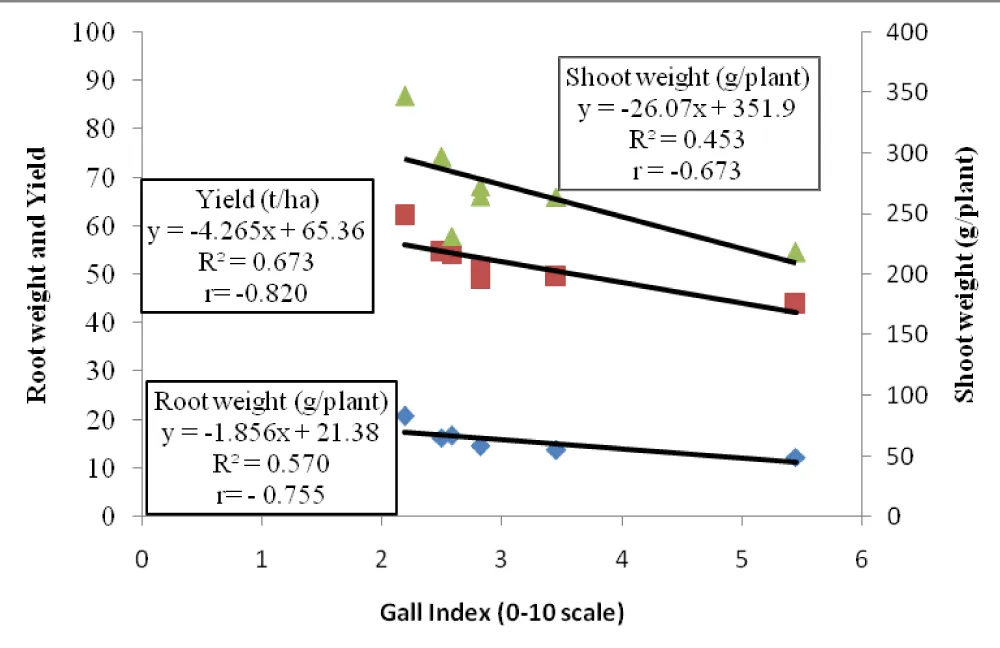
Correlation and regression analyses further confirmed the impact of neem treatments. The relationship between gall index and fruit yield, shoot weight, and root weight was linear and negative, with correlation coefficients (r) of 0.820, 0.673, and 0.755, respectively (Figure 1). The effects were significant, indicating that gall index accounted for 67.30% (R² = 0.673) of the variation in fruit yield, 45.30% (R² = 0.453) in shoot weight, and 57.00% (R² = 0.570) in root weight. These results demonstrate that neem-based soil amendments not only suppress nematode damage but also improve overall plant growth, likely due to the addition of essential nutrients and organic matter to the soil.
Download Image
Figure 1: Relationship of shoot weight, root weight, and fruit yield with gall index of tomato grown in soil inoculated with Meloidogyne incognita and treated with poultry neem oil cake, neem seed extract, neem leaf extract, neem leaf powder, neem oil, and Furadan 5G.
Although all treatments performed better than the control, neem oil cake and neem seed extract proved to be the most effective. These treatments significantly enhanced plant growth and yield parameters—including plant height, number of leaves, number of fruits, and fruit weight—while also reducing the soil nematode population and the number of root galls. Therefore, neem oil cake and neem seed extract can be recommended as suitable alternatives to synthetic nematicides for root knot nematode management.
The authors thankfully acknowledged the Bangladesh Agricultural Research Institute, Gazipur, for providing financial support and logistical support for the research. Thanks go to Mr. Md. Abdur Razzak and Mr. Zamil Akter (Scientific Assistant) for their assistance in completing the research in the field.
- Food and Agriculture Organization. FAO production yearbooks. Rome (Italy): Statistics Division, FAO. 1997;21:125–127. Available from: https://www.fao.org/4/w5800e/w5800e.pdf
- Hossain ME, Alam MJ, Hakim MA, Amanullah ASM, Ahsanulla. An assessment of physicochemical properties of some tomato genotypes and varieties grown at Rangpur. Bangladesh Res Publ J. 2010;4(3):135–243. Available from: https://www.semanticscholar.org/paper/AN-ASSESSMENT-OF-PHYSICOCHEMICAL-PROPERTIES-OF-SOME-Hossain-Alam/1120d6b54218d2fab038e0961600fdef0966ad18
- Sasser JN. Plant parasitic nematodes: the farmer’s hidden enemy. Raleigh (NC): North Carolina State University. 1989;7–14. Available from: https://www.semanticscholar.org/paper/Plant-parasitic-nematodes%3A-the-farmer%27s-hidden-Sasser/aad06138fd2d6554481e9e6a1c6d80a4baa2e05a
- Karssen G, Moens M. Root-knot nematodes. In: Perry RN, Moens M, editors. Plant nematology. Wallingford (UK): CABI Publishing. 2006;59–90. Available from: https://research.wur.nl/en/publications/root-knot-nematodes-3/
- Dropkin VH. Introduction to plant nematology. 2nd ed. New York: John Wiley & Sons; 1992.
- Moens M, Perry RN, Starr JL. Meloidogyne species – a diverse group of novel and important plant parasites. In: Perry RN, Moens M, Starr JL, editors. Root-knot nematodes. Wallingford (UK): CABI. 2009;1–17.
- Luc M, Sikora RA, Bridge J. Plant-parasitic nematodes in subtropical and tropical agriculture. 2nd ed. Wallingford (UK): CABI Publishing. 2005;331–871. Available from: https://www.researchgate.net/publication/236985095_Plant_Parasitic_Nematodes_in_Subtropical_and_Tropical_Agriculture_2nd_Edition
- Anwar SA, McKenry MV. Incidence and reproduction of Meloidogyne incognita on vegetable crop genotypes. Pak J Zool. 2010;42(2):135–141. Available from: https://zsp.com.pk/pdf/135-141%20(5).pdf
- Akhtar M, Malik A. Roles of organic soil amendments and soil organisms in the biological control of plant-parasitic nematodes: a review. Bioresour Technol. 2000;74:35–47.
- Chitwood DJ. Phytochemical-based strategies for nematode control. Annu Rev Phytopathol. 2002;40:221–249.
- Wachira PM, Kimenju JW, Okoth SA, Mibey RK. Stimulation of nematode-destroying fungi by organic amendments applied in management of plant parasitic nematodes. Asian J Plant Sci. 2009;8:153–159. Available from: https://scialert.net/abstract/?doi=ajps.2009.153.159
- Goswami BK, Neetu S. Combat the soil-borne fungal and root knot nematode diseases infecting horticultural crops. Amity CJ Biopest. 2012;5:255–258.
- Adegbite AA, Adesiyan SO. Root extracts of plants to control root-knot nematode on edible soybean. World J Agric Sci. 2005;1(1):18–21. Available from: https://idosi.org/wjas/wjas1(1)/4.pdf
- Ntalli NG, Caboni P. Botanical nematicides: a review. J Agric Food Chem. 2012;60(40):9929–9940.
- Umar I, Muhammad Z, Okusanya BAO. Effect of organic amendments on the control of Meloidogyne javanica on tomato (Lycopersicon lycopersicum). Agric Bus Tech. 2010;8:63–77.
- Isman MB. Botanical insecticides, deterrents, and repellents in modern agriculture and an increasingly regulated world. Annu Rev Entomol. 2006;51:45–66.
- Karyne A, Braga RS, Cavalcante CS. Nematicidal activity of neem oil and neem cake against Meloidogyne incognita. J Med Plants Res. 2013;7(22):1626–1632.
- Akhtar M. Nematicidal potential of the neem tree (Azadirachta indica) and its products. Integr Pest Manag Rev. 2000;5:57–66. Available from: https://link.springer.com/article/10.1023/A:1009609931223
- Javed N, El-Hassan S, Gowen S, Pembroke B, Inam-Ul-Haq M. The potential of combining Pasteuria penetrans and neem (Azadirachta indica) formulations as a management system for root-knot nematodes on tomato. Eur J Plant Pathol. 2008;120:53–60.
- Oka Y, Nacar S, Putievsky E, Ravid U, Yaniv Z, Spiegel Y. Nematicidal activity of essential oils and their components against the root-knot nematode. Phytopathology. 2000;90:710–715.
- Akhtar M, Mahmood I. Potentiality of phytochemicals in nematode control: a review. Bioresour Technol. 1994;48:189–201.
- Hussain MA, Mukhtar T, Kayani MZ. Management of root-knot nematode (Meloidogyne incognita) in tomato through the use of biofertilizers and organic amendments. Pak J Zool. 2016;48(5):1353–1358.
- Anonymous. Research report on horticultural crops (2006–07). Joydebpur (Bangladesh): Horticulture Research Centre, BARI. 2007;91.
- Zeck MW. A rating scheme for field evaluation of root-knot nematode infestation. Pflanzenschutz-Nachr. 1971;24:141–144. Available from: https://scispace.com/papers/a-rating-scheme-for-field-evaluation-of-root-knot-nematode-kfhruv4tja
- Singh K, Hali S. Nematicidal efficacy of neem (Azadirachta indica) seed extract against Meloidogyne incognita. Int J Plant Soil Sci. 2017;18(3):1–6. Available from: https://journalijpss.com/index.php/IJPSS/article/view/196
- Ntalli NG, Vargiu S, Menkissoglu-Spiroudi U, Caboni P. Nematicidal activity of natural compounds from neem tree (Azadirachta indica) against Meloidogyne incognita. J Agric Food Chem. 2009;57(3):579–583.
- Sharma HK, Singh S, Pankaj J. Management of Meloidogyne incognita with Paecilomyces lilacinus and neem cake on okra. Pestic Res J. 2007;19:166–168. Available from: https://arccjournals.com/journal/agricultural-science-digest/ARCC4422
- Rather MA, Siddiqui MA. Neem for the control of root-knot nematode infecting tomato. 2007;37(1):81–110.
- Ganai AM, Rehman B, Kavita P, Asi M, Siddiqui MA. Phytotherapeutic approach for the management of Meloidogyne incognita affecting Abelmoschus esculentus (L.) Moench. Arch Phytopathol Plant Prot. 2014;47:1797–1805. Available from: https://www.semanticscholar.org/paper/Phytotherapeutic-approach-for-the-management-of-Ganai-Rehman/06c7669bdb2a4b1d0a82b99dbe98be38721f3737
- Satyandra S, Rai AB, Singh RK. Bio-management of root-knot disease of chili (Capsicum annuum) caused by Meloidogyne incognita. Veg Sci. 2011;38(1):63–67. Available from: https://isvsvegsci.in/index.php/vegetable/article/view/663
- Babu, Rana L. Efficacy of neem products as seed treatment against Meloidogyne incognita in okra. Ann Plant Prot Sci. 2012;20(1):268–269.
- Archana US, Prasad D. Management of plant-parasitic nematodes by the use of botanicals. J Plant Physiol Pathol. 2014;2:1. Available from: https://www.scitechnol.com/peer-review/management-of-plantparasitic-nematodes-by-the-use-of-botanicals-C5lF.php?article_id=1809
- Resha M, Rani DS. Management of root-knot nematode (Meloidogyne incognita) using neem (Azadirachta indica). IOSR J Environ Sci Toxicol Food Technol. 2015;9(3):12–15. Available from: https://www.iosrjournals.org/iosr-jestft/papers/vol9-issue3/Version-3/C09331215.pdf
- Khan F, Javed N, Kamran M. Evaluation of the nematicidal potential of some botanicals against root-knot nematode (Meloidogyne incognita) infecting tomato. Pak J Nematol. 2019;37(1):59–64.
- Siddiqui ZA, Akhtar MS, Futai K. Biological control of plant-parasitic nematodes by fungi: a review. Biocontrol Sci Technol. 2007;17(8):837–852.
- Pandey G, Pandey RK, Pant H. Influence of organic amendments on nematode fauna and microflora of chickpea rhizosphere. Indian J Pulses Res. 2005;18:263–264.
- Kumar S, Khanna AS. Efficacy of Trichoderma viride and neem cake against root-knot nematode, Meloidogyne incognita on tomato. Pest Manag Econ Zool. 2006;14:103–106.
- Javed N, Gowen SR, El-Hassan SA, Inam-ul-Haq M, Shahina F. Systemic and persistent effect of neem (Azadirachta indica) formulations against root-knot nematodes, Meloidogyne javanica, on tomato. Crop Prot. 2007;26:36–43.
- Akhtar M, Alam MM. Control of plant-parasitic nematodes with organic and inorganic soil amendments. Plant Soil. 1990;132:195–199.
- Khan MR, Solanki RD, Bohra B, Vyas BN. Evaluation of Achook (azadirachtin 1500 ppm) against root-knot nematode (Meloidogyne incognita) infecting okra. South Asian J Exp Biol. 2012;2. Available from: https://sajeb.org/index.php/sajeb/article/view/83
- Gowda DN, Sreenivasa MN, Jagadeesh KS. Effect of neem-based products on suppression of root-knot nematode and growth promotion in tomato. J Pharmacogn Phytochem. 2018;7(5):1289–1294.
- Saranavanapriya B, Sivakumar M. Management of root-knot nematode, Meloidogyne incognita, on tomato with botanicals. Nat Prod Radiance. 2005;4:158–161.
- Alam MM, Ahmad M, Khan AM. Effect of organic amendments on the growth and chemical composition of tomato, eggplant, and chilli and their susceptibility to attack by Meloidogyne incognita. Plant Soil. 1979;51:231–236. Available from: https://link.springer.com/article/10.1007/BF02211683