
More Information
Submitted: December 22, 2025 | Accepted: January 12, 2026 | Published: January 13, 2026
Citation: Mulube M, Hamabwe S, Mukuma C, Lungu D, Parker T, Kamfwa K. Incidence and Severity of Common Bacterial Blight and Anthracnose Diseases of Common Bean in Northern Zambia: A Survey of Smallholder Farmers’ Fields. J Plant Sci Phytopathol. 2026; 10(1): 001-005. Available from:
https://dx.doi.org/10.29328/journal.jpsp.1001163
DOI: 10.29328/journal.jpsp.1001163
Copyright license: © 2025 Mulube M, et al. This is an open access article distributed under the Creative Commons Attribution License, which permits unrestricted use, distribution, and reproduction in any medium, provided the original work is properly cited.
Keywords: Anthracnose; Common bacterial blight; Incidence; Severity; Northern Zambia

Incidence and Severity of Common Bacterial Blight and Anthracnose Diseases of Common Bean in Northern Zambia: A Survey of Smallholder Farmers’ Fields
Mwiinga Mulube1.2#, Swivia Hamabwe1, Chikoti Mukuma2, Davies Lungu1, Travis Parker3 and Kelvin Kamfwa1*
1Department of Plant Sciences, University of Zambia, Great East Road, Lusaka, Zambia
2Zambia Agricultural Research Institute, Misamfu Research Station, Kasama, Zambia
3Department of Plant Sciences, University of California, MS11 Shields Avenue, Davis, CA 95616-8780, USA
*Address for Correspondence: Kelvin Kamfwa. PhD, Department of Plant Sciences, University of Zambia, Great East Road, Lusaka, Zambia, Email: [email protected]
Common bacterial blight (CBB) and anthracnose (ANTH) are major diseases of common bean (Phaseolus vulgaris L.) in Zambia. Both diseases are seedborne, and the use of infected farm-saved seed contributes to their transmission. Despite the socio-economic impact of CBB and ANTH, there is a lack of knowledge on their incidence and severity in northern Zambia, a region that accounts for 65% of total common bean production in the country. Also, there is a lack of knowledge on the use of certified seed vs. uncertified seed in this region. The objectives of this study were to determine: (i) the incidence and severity of CBB and ANTH in farmers’ fields of Northern Zambia, and (ii) the extent of use of certified seed compared to farm-saved uncertified seed. A total of 60 farmers’ fields were surveyed across 10 districts of northern Zambia for incidence and severity of CBB and ANTH. Both CBB and ANTH were observed in all the fields surveyed. However, CBB was more widely distributed with a mean incidence of 90.3% compared to 41.7% for ANTH. CBB was also more severe with a DII of 62.2% compared to 24.1% for ANTH. A total of 73.3% of the surveyed fields were planted with farm-saved seed, and only 26.7% were planted with certified seed. These results suggest that the incidence and severity of CBB and ANTH in northern Zambia are high, and the use of farm-saved seed is equally high, which makes it challenging to control both diseases given their seedborne nature of transmission. The study underscores the need for an integrated management strategy, including planting certified seed of varieties resistant to both CBB and ANTH, and the need for an effective seed system to deliver these improved varieties to smallholder farmers.
Common bean (Phaseolus vulgaris L.) is an important grain legume crop in Southern Africa, playing a critical role in household food security, nutrition, and income [1]. In Zambia, common bean is predominantly grown by resource-constrained smallholder farmers [2]. Common bean is grown in most parts of Zambia; however, economic production is concentrated in Northern, Luapula, Muchinga, and Northwestern regions of Zambia, which account for 65% of the total production in the country [3,4]. In the year 2023, total common bean production in Zambia was about 90,000 tonnes, from an area of 140,000 ha [5]. Productivity is still low, averaging about 0.65 tons/ha [5] compared to yields obtained in other African countries, for instance, 1.4 tonnes/ha in Tanzania, 1.5 tonnes/ha in Uganda, and 1.7 tonnes/ha in Ethiopia [6]. Zambia requires about 200,000 tonnes of common bean for consumption per annum, leaving a deficit of 110,000 tons if the year 2023 production is considered [7]. This deficit is normally covered by imports from Tanzania and South Africa. The low productivity of common bean in Zambia is caused by many factors, including the use of inherently low-yielding bean landraces and varieties, the use of uncertified farm-saved seed, poor agronomic practices, low soil fertility, little or no use of fertilizer, drought, pests, and diseases [2,8]. Common bacterial blight (CBB) and anthracnose (ANTH) are major diseases of common bean in Zambia [9,10].
CBB caused by the bacterium Xanthomonas axonopodis pv Phaseoli (Xap) and its variant Xanthomonas fuscans spp fuscans (Xff) is a seed-borne disease that causes yield losses of up to 40% if not controlled and significant grain quality losses. Its development and damage are favoured by high humidity, frequent winds, and high temperatures of between 280 °C and 320 °C. Symptoms normally appear on the aerial parts of the plant. On leaves, symptoms first appear as water-soaked spots that later enlarge and coalesce to form brown lesions causing leaf blight, while on pods, it appears as circular, sunken, and dark brown lesions [11,12]. When severe, the disease causes discoloration and shrivelling of the grain, thereby reducing grain quality. Planting of infected seed is the primary transmission; however, transmission can occur through other means, such as infected crop residues.
ANTH caused by the fungus Colletotrichum lindemuthianum is equally a seedborne disease that causes yield losses of up to 100% if not controlled [13]. It can infect the common bean plant at any growth stage, and symptoms may appear as rust-brown to black lesions on leaf veins, petioles, and underside [14]. As the disease progresses along the vascular system, it creates rust brown to dark coloured lesions which later enlarge into round sunken canker eyespots [15]. The canker spots will also appear on the pods, thereby reducing seed yield [16]. The disease is favoured by cool and wet weather conditions [14]. Disease transmission is mainly through infected seed, rain splash, and crop residues.
Despite the socio-economic importance of CBB and ANTH, knowledge on their incidence and severity in the major common bean-producing districts of northern Zambia is unknown, yet this knowledge is critical to developing interventions to mitigate the yield losses caused by these two diseases. Also, there is a paucity of information on the extent to which farmers use certified seed compared to farm-saved uncertified seed. This knowledge is critical to assessing the effectiveness of a seed system for beans in Zambia to serve smallholder farmers. The objectives of this study were to determine: (i) the incidence and severity of CBB and ANTH in farmers’ fields of northern Zambia, and (ii) the extent of use of certified common bean seed compared to farm-saved uncertified seed.
Study area
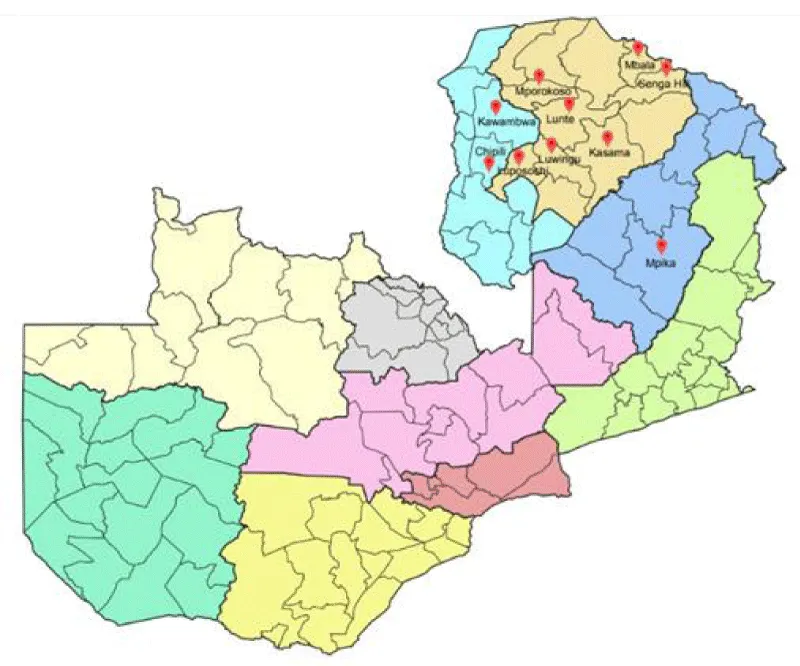
The study was conducted in 10 districts of Northern Zambia, previously reported to have high common bean production [5]. Figure 1 shows the locations of the 10 districts on the map of Zambia. Two agricultural camps (extension catchment area) were selected from each target district: Kasama district (Kapanda and Munkonge), Mporokoso (Chalabesa and Chisha Mwamba), Lunte (Chitoshi and Kapatu), Luwingu (Luwingu main and Fikonkote), Lupososhi (Mufili and Chungu), Chipili (Lupososhi and Kashimba), Kawambwa (Musungu and Folotiya), Senga (Senga and Mwiluzi), Mbala (Lucheche and Masamba), and Mpika (Chintu and Mufubushi) districts. Each camp in a district was considered a replication. The agricultural camps that were chosen are those previously reported to have high common bean production [5]. All the selected districts fall in agro-ecological region III, receiving an annual rainfall of between 1000 and 1500 mm from November to April. The geographic and climatic information about the 10 districts is shown in Table 1.
| Table 1: Geographic and climatic information about the 10 districts in northern Zambia that were targeted for survey on incidence and severity of common bacterial blight and anthracnose, and extent of use of certified seed of common bean. | |||||
| District | Latitude | Longitude | Altitude (masl) | Temp (°C) | Rainfall (mm) |
| Kasama | 10.31 | 30.68 | 1387 | 17 - 27 | 1200 - 1400 |
| Mporokoso | 9.33 | 30.00 | 1444 | 18 - 25 | 1200 - 1400 |
| Lunte | 9.71 | 30.68 | 1544 | 22 - 24 | 1200 - 1400 |
| Luwingu | 10.18 | 29.94 | 1266 | 21 - 23 | 1200 - 1400 |
| Lupososhi | 10.34 | 29.45 | 1295 | 18 - 24 | 1200 - 1400 |
| Chipili | 10.66 | 29.10 | 1280 | 22 - 28 | 1100 - 1300 |
| Kawambwa | 10.17 | 29.72 | 1487 | 19 - 23 | 1300 - 1500 |
| Senga | 9.46 | 31.15 | 1504 | 19 - 23 | 1000 - 1200 |
| Mbala | 8.82 | 31.40 | 1643 | 20 - 22 | 1200 - 1400 |
| Mpika | 11.66 | 31.45 | 1412 | 21 -23 | 1000 - 1200 |
| Temp = Temperature, masl = meters above sea level, mm = millimetres | |||||
Field survey
The field surveys were conducted in the years 2022 and 2023 between the months of March and April, which coincided with the flowering and pod filling stages. Three farmers’ fields were selected for evaluation per agricultural camp. In each of the selected fields, five spots within the field were identified at random in a transect walk of 5-10 m apart, from which CBB and ANTH assessments were conducted.
Evaluation of CBB and ANTH incidence
At each selected spot within the field, 20 consecutive plants were evaluated for disease incidence. Incidence was then calculated following the formula described by Girma et al. [17].
Equation 1
Evaluation of CBB and ANTH severity
In common bean, the severity of CBB and ANTH is commonly assessed using visual severity scores, as these provide a rapid and effective means of identifying resistant genotypes. In this study, CBB and ANTH severity were rated using a previously described visual scale of 1-5 [6,18,] where 1 = no symptoms, 2 = 1-30% foliage affected, 3 = 30-65% foliage affected, 4 = 66-100% foliage affected, and 5 = dead plant. Two samples of diseased leaves were collected per genotype for laboratory-based pathogen characterization.
CBB and ANTH intensity index
The mean incidence and severity values were then used to calculate the disease intensity index (DII), which measures the levels of damage associated with CBB or ANTH. DII was calculated using the formula shown below:
Equation 2
Where I = Mean disease incidence (%), S = mean severity score of foliar symptoms, and M = maximum severity value.
Use of certified seed and improved varieties
Because both CBB and ANTH are mainly spread through seed, farmers were asked about the source of seed used for planting. Additionally, farmers were asked whether they were growing landraces or improved varieties.
Phenotypic data analyses
All incidence, severity, and disease intensity index data analyses were conducted using the package “agricolae” and base packages in the software R. Analysis of variance (ANOVA) was initially conducted using combined data of the two growing seasons following the statistical model shown in equation 3. This analysis indicated significant district-by-year interaction effects for all traits except CBB severity; therefore, all traits except CBB severity were analyzed separately for each year using the statistical model in equation 2.
Equation 3
Y = µ + District + Year+Rep(District) + [District*Year] + Error
Equation 4
Y = µ + District + Rep+ Error
Where: Y is the response variable (incidence, severity, or DII); µ is the population mean; District was considered fixed; Year was considered random; Rep was replication within a district (camp within a district) and considered random; District*Year was the interaction effect, which was considered random; Error was considered random.
Disease incidence
The CBB and ANTH incidences obtained per district in each surveyed season and across seasons are shown in Table 2. There were significant (p < 0.05) differences for both CBB and ANTH incidences among the 10 districts surveyed across the two growing seasons. ANOVA for the individual growing season also showed significant differences (p < 0.05) among the 10 districts. In the 2022 and 2023 growing seasons, the mean incidence of CBB across the ten surveyed districts was 90.6% and 89.9%, respectively. CBB incidence by district ranged 68 - 100% and 83.3-97.5% in the 2022 and 2023 growing seasons (Table 2). Generally, ANTH incidence was lower than CBB for both the 2022 and 2023 growing seasons. In the 2022 season, ANTH incidence ranged 23.5-91.7% and 8.3-41.5% for the 2022 and 2023 growing seasons, respectively.
| Table 2: Incidences of common bacterial blight and anthracnose diseases of common bean in the surveyed ten districts of northern Zambia in the 2022 and 2023 growing seasons. | ||||
| CBB Incidence (%) | ANTH Incidence (%) | |||
| District | 2022 | 2023 | 2022 | 2023 |
| Luwingu | 68 | 89.5 | 23.5 | 18.8 |
| Kasama | 81.5 | 84.5 | 86.7 | 18.2 |
| Mbala | 87.7 | 92.2 | 23.8 | 8.3 |
| Kawambwa | 91.8 | 90.3 | 71.8 | 41.5 |
| Lunte | 93 | 89.8 | 62.5 | 35 |
| Mporokoso | 100 | 83.3 | 80 | 12.3 |
| Senga | 100 | 85 | 45.8 | 11 |
| Lupososhi | 92.8 | 92.5 | 91.7 | 32.2 |
| Chipili | 91.3 | 97.5 | 81.8 | 37.3 |
| Mpika | 100 | 94.7 | 35 | 15.5 |
| Mean | 90.6 | 89.9 | 60.3 | 23 |
| CBB = Common bacterial blight; ANTH = Anthracnose | ||||
Disease severity
CBB was more severe than ANTH in the surveyed districts. There were no significant differences (p > 0.05) among the ten districts surveyed for CBB severity. The mean disease severity across the growing seasons ranged from 3.1 to 3.6, with a mean of 3.4 (Table 3). Significant differences (p < 0.05) were observed among the ten districts in ANTH severity across the two growing seasons. ANOVA for ANTH for each of the growing seasons also showed significant differences (p < 0.05). ANTH severity ranged from 1.7 to 3.7 and 1.2 to 2.1 for the 2022 and 2023 growing seasons, respectively (Table 3). Mbala district recorded the lowest ANTH severity for both growing seasons.
| Table 3: Severity of common bacterial blight and anthracnose diseases of common bean in the surveyed ten districts of northern Zambia in the 2022 and 2023 growing seasons. | |||||
| District | CBB Severity | ANTH Severity | |||
| 2022 | 2023 | Mean | 2021/22 | 2022/23 | |
| Kasama | 3 | 3.1 | 3.1 | 3.7 | 1.3 |
| Mbala | 2.7 | 3.4 | 3.1 | 1.7 | 1.2 |
| Luwingu | 2.6 | 3.8 | 3.2 | 2 | 1.5 |
| Senga | 3.8 | 3.1 | 3.4 | 2.6 | 1.3 |
| Lupososhi | 3.2 | 3.82 | 3.5 | 3.6 | 1.7 |
| Kawambwa | 3.5 | 3.56 | 3.5 | 2.9 | 2.1 |
| Mporokoso | 3.8 | 3.22 | 3.5 | 2 | 1.3 |
| Lunte | 3.4 | 3.68 | 3.5 | 2.2 | 1.9 |
| Mpika | 3.8 | 3.28 | 3.5 | 2 | 1.4 |
| Chipili | 3.4 | 3.84 | 3.6 | 3.4 | 1.9 |
| Mean | 3.3 | 3.5 | 3.4 | 2.6 | 1.6 |
| CBB = Common bacterial blight, ANTH = Anthracnose, LSD = Least Significant difference | |||||
Disease intensity index
Significant differences (p < 0.05) were observed among the ten districts in both CBB and ANTH intensity indices across the two growing seasons. ANOVA for individual growing seasons also showed significant differences (p < 0.05) among the 10 districts for both growing seasons. CBB DII ranged 31.8-76.1 and 53.1-74.9 for 2022 and 2023 growing seasons, respectively (Table 4). For ANTH DII ranged 14.7-68.1 and 2.1-24.8 for 2022 and 2023 growing seasons, respectively (Table 4). The ANTH DII in 2022 was higher (38.9) than in 2023 (9.3).
| Table 4: Disease Intensity Index of common bacterial blight and anthracnose diseases of common bean in the surveyed ten districts of northern Zambia in the 2022 and 2023 growing seasons. | ||||
| District | CBB DII | ANTH DII | ||
| 2022 | 2023 | 2022 | 2023 | |
| Luwingu | 31.8 | 69.6 | 14.7 | 6.1 |
| Kasama | 49.4 | 53.5 | 67.2 | 5.4 |
| Mbala | 47.4 | 64.3 | 15.9 | 2.1 |
| Senga | 74.9 | 53.1 | 31.6 | 2.9 |
| Kawambwa | 62.9 | 65.4 | 49.2 | 24.8 |
| Lunte | 62.7 | 68.7 | 33.8 | 15.2 |
| Lupososhi | 59.2 | 72.4 | 68.1 | 11.5 |
| Mporokoso | 76.8 | 55.7 | 32.5 | 3.6 |
| Chipili | 61.6 | 74.9 | 58.1 | 15.7 |
| Mpika | 76.1 | 62.3 | 17.4 | 5.3 |
| Mean | 60.3 | 64 | 38.9 | 9.3 |
| CBB = Common bacterial blight; ANTH = Anthracnose; DII = Disease Intensity Index; LSD = Least Significant difference | ||||
Usage of certified seed and improved varieties
The study indicated that a total of 208 common bean varieties were cultivated in the 10 surveyed districts. Out of this, 18 were improved varieties while 190 were landraces. The landraces and varieties were in variable market classes that included red, yellow, red mottled, sugar, white, black, Khaki, cream, purple, brown, and others. Of the surveyed farmers, 60 surveyed farms/farmers, 73.3% used farm-saved seed (recycled seed) mainly of landraces, while only 26.7% of the farmers planted certified seed accessed from agro-dealers, Zambia Agricultural Research Institute, and seed companies (Table 5).
| Table 5: Percentage of farmers using either certified or farm-saved common bean seed for planting in the surveyed 10 districts of northern Zambia. | ||
| Source | Number of Farmers | Percentage |
| Farm-saved/ Recycled Seed | 44 | 73.3 |
| Certified Seed | 16 | 26.7 |
CBB and ANTH are major diseases of common bean that cause significant seed yield and quality losses in Zambia. Knowledge of the incidence and severity of the two diseases is critical to developing strategies to mitigate these losses. Both diseases are seedborne, and the use of infected seed for planting is the primary mode of transmission. In this study, a survey was conducted to determine the incidence, severity, and disease intensity indices for both diseases in 10 districts located in northern Zambia. Additionally, information on the extent to which farmers use certified seed or farm-saved seed was assessed.
The study showed high incidence and severity for both CBB and ANTH in all 10 districts for the two growing seasons, suggesting infections of the two diseases were widespread and could have caused significant yield losses in this northern production hub of common bean, which accounts for 65% of the total common bean production in Zambia. The incidence of CBB was significantly higher than ANTH, and this is consistent with reports from other countries such as Ethiopia [17]. However, seed yield losses due to ANTH tend to be higher than those of CBB, indicating that, though the incidence of ANTH may be lower than that of CBB, it may have caused higher seed yield loss than CBB in the ten surveyed districts. The high incidence and severity of both diseases threaten the household income and food security of households in northern Zambia. The observed high incidence and severity of CBB and ANTH underscore the need for mitigation strategies for both diseases. This would require an integrated management strategy. This could include chemical control. While chemical control is highly effective for ANTH, it is less effective for CBB. But even for ANTH, where chemical control is effective, its use is limited because common bean in all ten districts is produced by smallholder farmers who cannot afford to purchase the fungicide. One other control strategy would be planting of disease-free certified seed of resistant varieties. But as suggested by the current study, most of the surveyed farmers (73.3%) were using farm-saved seed of mostly landraces that are susceptible to both CBB and ANTH, a practice that could be contributing to the widespread incidence and severity of the two diseases in the surveyed districts. The study underscores the need for continuous efforts towards the development and use of resistant varieties to CBB and ANTH. The result of this study, which has shown low usage of certified seed of improved varieties, shows the lack of effectiveness of the current seed system to deliver improved varieties to the smallholder farmers. The disease intensity indices, which measure the level of damage associated with common bacterial blight, were also very high across districts, with the highest being Mpika (69.2%), Chipili (68.3%), Mporokoso (66.3%), and Lupososhi (65.8%). The intensity of common bacterial blight was similar among districts; however, highly significant differences were observed among districts across seasons. A mean CBB intensity of 60.3 was recorded in 2022, and a mean of 64% in 2023, while the average between the two seasons was 62.3%, this could be attributed to recurring infections due to recycling of seed, coupled with favourable conditions for disease development. Significant district-by-year interactions were observed for both CBB and ANTH, suggesting that incidence varied depending on the growing season, and this could be attributed to differences in the amount and distribution of rainfall and temperature between the two growing seasons.
Despite this study providing valuable insights into the severity of CBB and ANTH in common bean smallholder farms in Zambia, it has one major limitation, i.e., the absence of yield loss data. The absence of yield loss data constrained the ability to directly quantify yield losses and, consequently, to assess the socio-economic impact of these diseases on smallholder farmers in Zambia. As a result, inferences regarding the economic implications of CBB and ANTH were limited to disease severity observations rather than direct productivity outcomes. Future studies incorporating yield loss data would enable a more comprehensive evaluation of the impact of these diseases and strengthen recommendations for breeding and disease management strategies.
Both CBB and ANTH were observed in all the fields surveyed. However, CBB was more widely distributed with a mean incidence of 90.3% compared to 41.7% for ANTH. CBB was also more severe with a DII of 62.2% compared to 24.1% for ANTH. A total of 73.3% of the surveyed fields were planted with farm-saved seed, and only 26.7% were planted with certified seed. These results suggest that the incidence and severity of CBB and ANTH in northern Zambia are high. The study underscores the need for an integrated management strategy for both diseases, including the use of clean certified seed of resistant varieties and an effective seed system to deliver these improved varieties to smallholder farmers in Zambia.
- Raatz B, Mukankusi C, Lobaton JD, Male A, Chisale V, Amsalu B, et al. Analyses of African common bean (Phaseolus vulgaris L.) germplasm using a SNP fingerprinting platform: diversity, quality control, and molecular breeding. Genet Resour Crop Evol. 2019;66(3):707-722. Available from: https://doi.org/10.1007/s10722-019-00746-0
- Hamazakaza P, Katungi E, Reyes B, Maredia M, Muimui K, Ojara M. Assessing access and adoption of common bean improved varieties in Zambia. CGIAR Working Paper. 2014 Nov;1-42. Available from: https://doi.org/10.13140/RG.2.1.4687.4729
- Sichilima T, Mapemba L, Tembo G. Drivers of dry common beans trade in Lusaka, Zambia: a trader’s perspective. Sustain Agric Res. 2016;5(2):15. Available from: https://doi.org/10.5539/sar.v5n2p15
- Ministry of Finance and National Planning (ZM). Zambia’s Eighth National Development Plan: socio-economic transformations for livelihoods. Lusaka: Government of the Republic of Zambia; 2022. Available from: https://www.zda.org.zm/wp-content/uploads/2022/09/8th-NDP-2022-2026.pdf
- Zambia Statistics Agency (ZamStats). Zambia crop focus survey. Lusaka: ZamStats; 2023.
- Tugume JK, Tusiime G, Sekamate AM, Buruchara R, Mukankusi CM. Diversity and interaction of common bacterial blight disease-causing bacteria (Xanthomonas spp.) with Phaseolus vulgaris L. Crop J. 2019;7(1):1-7. Available from: https://doi.org/10.1016/j.cj.2018.10.002
- Harris J, Chisanga B, Drimie S, Kennedy G. Nutrition transition in Zambia: changing food supply, food prices, household consumption, diet, and nutrition outcomes. Food Secur. 2019;11(2):371-387. Available from: https://doi.org/10.1007/s12571-019-00903-4
- Hamabwe SM, Otieno NA, Soler-Garzón A, Miklas PN, Parker T, Kramer DM, et al. Identification of quantitative trait loci for drought tolerance in the Bukoba/Kijivu Andean mapping population of common bean. Theor Appl Genet. 2023;136(11):222. Available from: https://doi.org/10.1007/s00122-023-04463-2
- Muimui KK, Kimani PM, Muthomi JW. Resistance and inheritance of common bacterial blight in yellow bean. Afr Crop Sci J. 2011;19(4):277-287. Available from: https://hdl.handle.net/10568/97069
- Sinkala W, Hamabwe S, Kuwabo K, Mukuma C, Kamfwa K. Genome-wide association analysis of resistance to anthracnose in the Middle American Diversity Panel of common bean (Phaseolus vulgaris L.). Crop Sci. 2024;64(6):3126-3134. Available from: https://doi.org/10.1002/csc2.21335
- Harveson RM. Common bacterial blight of dry beans in Nebraska. Univ Nebraska-Lincoln Ext Publ. 1969;2-4. Available from: https://extensionpubs.unl.edu/publication/g1956/2009/pdf/view/g1956-2009.pdf
- Harveson RM, Schwartz HF. Bacterial diseases of dry edible beans in the central high plains. Plant Health Prog. 2007. Available from: https://doi.org/10.1094/PHP-2007-0125-01-DG
- Nalupya Z, Hamabwe S, Mukuma C, Lungu D, Gepts P, Kamfwa K. Characterization of Colletotrichum lindemuthianum races in Zambia and evaluation of the CIAT Phaseolus core collection for resistance to anthracnose. Plant Dis. 105(12):3939-3945. Available from: https://doi.org/10.1094/pdis-02-21-0363-re
- Mohammed A. An overview of distribution, biology, and the management of common bean anthracnose. J Plant Pathol Microbiol. 2013;4(8). Available from: https://doi.org/10.4172/2157-7471.1000193
- Sansala M, Kuwabo K, Hamabwe SM, Kachapulula P, Parker T, Mukuma C, et al. Race structure and molecular diversity of Colletotrichum lindemuthianum of common bean in Zambia. Plant Dis. 2024;108(4):857-865. Available from: https://doi.org/10.1094/pdis-01-23-0143-re
- Padder BA, Sharma PN, Awale HE, Kelly JD. Colletotrichum lindemuthianum is the causal agent of bean anthracnose. J Plant Pathol. 2017;99:317-330. Available from: https://doi.org/10.4454/jpp.v99i2.3867
- Girma F, Fininsa C, Terefe H, Amsalu B. Distribution of common bacterial blight and anthracnose diseases and factors influencing epidemic development in major common bean growing areas in Ethiopia. Acta Agric Scand B Soil Plant Sci. 2022;72(1):685-699. Available from: https://doi.org/10.1080/09064710.2022.2063168
- Bejarano-Alcázar J, Blanco-López MA, Melero-Vara JM, Jiménez-Díaz RM. Etiology, importance, and distribution of Verticillium wilt of cotton in southern Spain. Plant Dis. 1996;80(11):1233-1238. Available from: https://www.apsnet.org/publications/plantdisease/backissues/Documents/1996Articles/PlantDisease80n11_1233.pdf